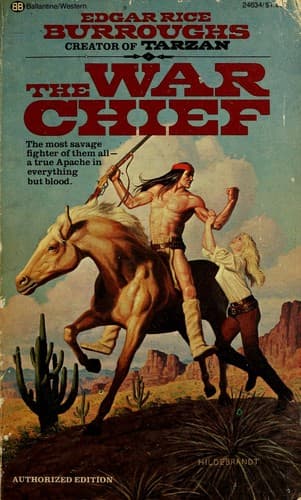
Apache Indians -- Fiction; Historical fiction; Western stories
“I reckon I know what you mean,” she said. “We don’t talk alike. I know
it. You aint a-goin’ to hurt my feelings, because I know you aint makin’
fun of me—and I wouldn’t even care if you did, if you’d help me.
“I was born on a farm in Kansas and what school they was was too fer off
to go to only a few weeks in the fall and spring. I didn’t learn much of
nothin’ there. Maw died when I was little. Dad learned me all he
knew—how to read and write a little and figger. If I only had somethin’
decent to read, or educated folks to talk to me. I know I got it in me
to be—to be different. If there was only some way.”
“There is a way,” said King, who had been thinking very hard for the
past several minutes. “There is a way.”
“What?”
“There are some very wonderful women at the post—refined, cultured,
educated women, the wife of my troop commander, for instance. One of
them would be glad to have you come there. Any one of them would help
you. Would you come, Chita?”
“As what?”
“As the guest of one of these ladies?”
“I don’t know none of ’em. I don’t think they’d want me.”
“Yes they would. The Captain’s wife is an old friend of my mother’s.
She’s been wonderful to me since I joined and I know she’d love to have
you. These women get terribly lonesome way out here, especially when
their husbands are in the field. You would be a Godsend to Mrs. Cullis.”
And that is how it happened that Wichita Billings came to Fort Thomas as
the guest and ward of Margaret Cullis. Her beauty, her eagerness to
learn disarmed all criticism, forestalled all ridicule—the one thing
that Wichita Billings could not have survived, the thing that she had
feared most. Yet she made so much fun of her own crude diction that
those who might have otherwise found in her a target for witty thrusts
were the first to defend her.
Up out of Sonora came Shoz-Dijiji searching for his people. With him he
brought a dozen ponies and some mules, toll that he had collected from
the enemy in northern Sonora and southern Arizona. Behind him he left a
few smoking piles of embers where homes had been or wagons, a few new
corpses, killed without torture, left without mutilation.
The Be-don-ko-he welcomed him without enthusiasm. He took his place
among them as though he had not been away. The mules he gave for a great
feast and he had presents for Geronimo, Gian-nah-tah and Sons-ee-ah-ray.
Ish-kay-nay they did not mention, nor did he. Sorrow, parting, death are
but a part of the pathetic tragedy that marks the passing of the Indian;
they had taken no greater toll of Shoz-Dijiji than of many another of
his tribe. Why then should he flaunt his sorrow in the faces of those
whose burdens were as great as his?
Of his warlike deeds he spoke sparingly, though he was too much the
Apache brave to ignore them entirely; but there had come word of his
doings out of Mexico and his rating became second to none among all the
six tribes. Geronimo was very proud of him.
Public-domain text, read in full here on John Shaqi.
Reviews
Reviews
No reviews yet
Be the first to share your thoughts on this work.
Elsewhere in the archive
Join the Discussion
Join the discussion
Sign in to leave a comment or review.
Sign InorCreate an account