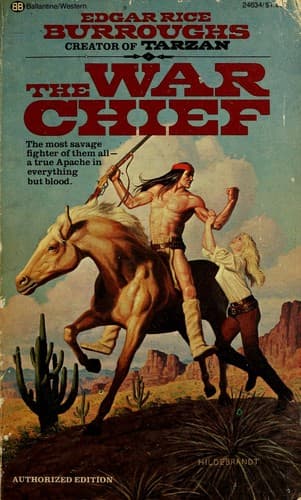
Apache Indians -- Fiction; Historical fiction; Western stories
He saw the rout of the Mexicans and he joined the rush of yelling,
whooping braves that swarmed down the sides of the canyon to dispatch
the wounded and loot the dead. In his path a wounded Mexican raised
himself upon one elbow and Shoz-Dijiji shot him through the throat. As
the trooper sank to earth again the lad drew his hunting knife and
scalped him, and his eyes blazed with the deep fire of what was almost
religious exaltation as he consummated this act in the Apaches’ sacred
drama—war.
All about him the warriors were torturing the living and mutilating the
dead and Shoz-Dijiji watched, interested; but he did not follow their
examples in these things. Why he did not, he could not have told. He
felt neither pity nor compassion, for he had been taught neither one nor
the other by precept or example. Deep within him, perhaps, there was
forming, nebulously, the conviction that in after years guided him in
such matters, that it added nothing to the luster of a warrior’s fame to
have the blood of the defenseless upon his weapons.
He could kill with savage delight, but he took no joy in the sufferings
of his victims; and in this respect he was not the only exception among
his fellows to the general rule that all Apaches took delight in
inflicting diabolical sufferings upon the helpless. This was not the
first time that he had seen Mexican soldiers fight, and having found
them fearless and worthy foes he had conceived for them that respect
which every honorable fighting man feels for a brave antagonist. To have
killed one, then, was a high honor and Shoz-Dijiji was filled with
justifiable pride as he viewed the dripping trophy of his prowess.
Geronimo, blood-spattered, grim, terrible, saw him and smiled, and
passed on to send a small party after the retreating Mexicans who had
escaped, that he might be assured that there was not a larger party of
the enemy to the south, or that the others did not turn back to seek
revenge.
The grim aftermath of an Apache victory completed, the victorious
warriors, laden with loot and bearing a few scalps, returned, exulting,
boasting, to the camp, where the women and children greeted them with
shrill cries of praise.
That night there was feasting and dancing—the scalp dance—and the loot
was divided.
The following day four of the tribes withdrew to separate camps short
distances apart, leaving only the Be-don-ko-he and the Cho-kon-en in the
main camp, and there they waited until the trailers had returned and
reported that the Mexicans had crossed the border in retreat; then they
scattered to their own hunting grounds.
Public-domain text, read in full here on John Shaqi.
Reviews
Reviews
No reviews yet
Be the first to share your thoughts on this work.
Join the Discussion
Join the discussion
Sign in to leave a comment or review.
Sign InorCreate an account