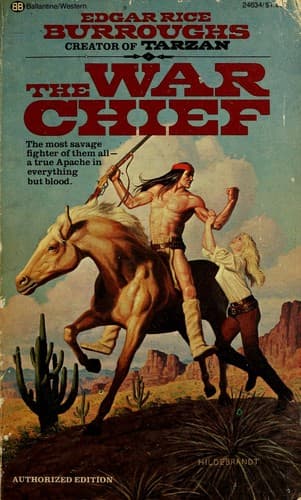
Apache Indians -- Fiction; Historical fiction; Western stories
Ish-kay-nay’s pony, none the worse for its spill, had scrambled to its
feet and trotted away a short distance, where it was now contentedly
feeding upon the grama grass. Still farther away the boy’s mount
browsed. Shoz-Dijiji looked toward it and whistled—once, shrilly. The
pony raised its head and looked in the direction of the sound, then it
started toward its master, slowly at first; but at the second whistle,
more peremptory than the first, it broke into a gallop and came rapidly
to stop before the lad.
Shoz-Dijiji mounted and drew Ish-kay-nay up behind him, but when they
sought to catch the girl’s pony it snorted and ran away from them.
Herding it toward camp the two rode in the direction of their fellows,
some of whom had regained their ponies; and so, several of them mounted
double, driving the riderless animals ahead, they came back to camp.
Thus the happy days rolled by with hunting, with games, with play; or
there were long trails that led down into Sonora or Chihuahua; there
were raids upon Mexican villages; upon wagon trains; upon isolated
ranches; there were the enemy’s attacks upon their own camps. In the
springs there was the planting if the tribe chanced to be in a permanent
camp and then, with wooden hoes, the children and the squaws broke the
ground, planted the corn in straight rows, melons and pumpkins at
haphazard about the field, and the beans among the corn.
Sometimes the children, tiring of so much work, would run away to play,
staying all day and sneaking into camp at dark, nor were they ever
chided by their elders; but woe betide them should one of these discover
them in their hiding place, for the ridicule that was sure to follow was
more bitter to the Apache taste than corporal punishment would have
been.
As the boys, playing, learned to use the weapons of their people, to
track, to hunt, to fight, so the girls learned the simple duties of
their sex—learned to prepare the maguey for each of the numerous
purposes to which their people have learned to put this most useful of
plants; learned to grind the mesquite bean into meal and make cakes of
it; learned to dry the fruit of the Spanish bayonet; to dress and tan
the hides that the braves brought in from the chase.
And together the children, under the admiring eyes of their elders,
learned the gentle art of torture, practicing upon birds and animals of
the wild and even upon the ponies and dogs of the tribe. Upon these
activities Shoz-Dijiji looked with interest; but for some reason, which
he doubtless could not have understood had he tried to analyze it, he
found no pleasure in inflicting pain upon the helpless; nor did this
mark him particularly as different from his fellows, as there were
others who shared his indifferences to this form of sport. Apaches are
human and as individuals of other human races vary in their
characteristics, so Apaches vary. The Apaches were neither all good, nor
all bad.
Public-domain text, read in full here on John Shaqi.
Reviews
Reviews
No reviews yet
Be the first to share your thoughts on this work.
Join the Discussion
Join the discussion
Sign in to leave a comment or review.
Sign InorCreate an account