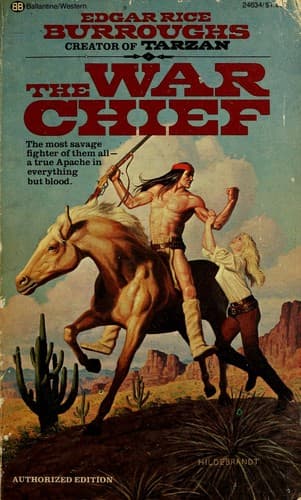
Apache Indians -- Fiction; Historical fiction; Western stories
Together the two boys left the camp, heading deep into the mountains,
Shoz-Dijiji leading, Gian-nah-tah stepping directly in his tracks. They
did not speak, but moved silently at a dog trot, for the time was short.
Better would it have been to have spent days and nights in preparation,
but now this could not be. A mile from camp Gian-nah-tah turned to the
left, following a branch of the main canyon up which Shoz-Dijiji
continued for a matter of several miles, then, turning abruptly to the
right he scaled the sloping base of the canyon wall.
Where the fallen rubble from above ended against the rocky cliff side
the blackened stump of a lightning-riven pine clung precariously. Here
Shoz-Dijiji paused and, searching, found a flat splinter of wood not
three inches long nor an inch wide and quite thin. With a slender
buckskin thong he tied the splinter securely to his G-string and
commenced the ascent of the nearly perpendicular cliff that towered high
above him.
Taking advantage of each crevice and projection the lad crept slowly
upward. Scarcely was there an instant when a single slip would not have
hurled him to death upon the tumbled rocks below, and yet he never
paused in his ascent, but moved as confidently as though on level
ground, up and up, until, three hundred dizzy feet above the canyon
floor he drew himself to a narrow, nichelike ledge. Settling himself
here with his back against the cliff and his legs dangling over the
abyss, he unfastened the pine splinter from his G-string and with his
hunting knife set to work to fashion it to his purpose.
For an hour he worked unceasingly until the splinter, smoothed upon its
two flat sides, suggested, roughly, the figure of a short legged,
armless man, and had been whittled down to a length of two and a quarter
inches and a width of about a sixth of its greatest dimension. Upon one
flat side he carved zigzag lines—two of them running parallel and
longitudinally. These represented ittindi, the lightning. Upon the
opposite side he cut two crosses and these he called intchi-dijin, the
black wind. When he had finished the carving he tied it firmly to a
thong of buckskin which formed a loop that would pass over his head and
hang about his neck.
Thus did Shoz-Dijiji, the Black Bear, fashion his tzi-daltai.
From a buckskin bag upon which Morning Star had sewn pretty beads the
boy took a still smaller bag containing hoddentin, a pinch of which he
sprinkled upon each side of the tzi-daltai, and then he tossed a pinch
out over the cliff in front of him and one over his left shoulder and
one over his right and a fourth behind him.
“Be good, O, winds!” he prayed.
Another pinch of hoddentin he tossed high in air above him. “Be good, O,
ittindi! Make strong the medicine of Shoz-Dijiji that it may protect him
from the weapons of his enemies.”
Public-domain text, read in full here on John Shaqi.
Reviews
Reviews
No reviews yet
Be the first to share your thoughts on this work.
Join the Discussion
Join the discussion
Sign in to leave a comment or review.
Sign InorCreate an account