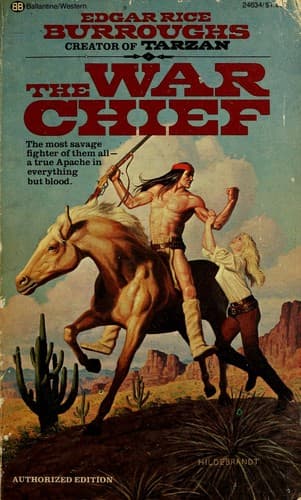
Apache Indians -- Fiction; Historical fiction; Western stories
In the gory lexicon of Apache military science there appears no such
word as chance. To risk one’s life, to sacrifice one’s warriors
needlessly, is the part of a fool, not of a successful war chief. To
give the other fellow a chance is the acme of asininity. In the event of
battle men must be killed. If all the killed are among the enemy so much
greater is the credit due the victorious chief. They have reduced the
art of war to its most primitive conception; they have stripped it stark
to its ultimate purpose, leaving the unlovely truth of it quite naked,
unadorned by sophistries or hypocrisies—to kill without being killed.
At length Geronimo was convinced of the truth he had at first
sensed—that the Mexicans were most vulnerable during their midday rest.
Then their wagons were not parked into a circular fortress. The men were
hot and tired and drowsy. They were lulled into a fancied security by
the fact that they could see to great distances in all directions.
Nothing as large as a man could approach them unseen. He had even noted
that upon one occasion the entire party had dozed simultaneously at a
noonday stop, and he made his plans accordingly.
From his intimate knowledge of the country, the trail, and the customs
of freighters he knew where the noon stop upon the third day of the
trailing would be made. That forenoon only one Apache trailed the
unsuspecting Mexicans; the others were far ahead.
Noon approached. The complaining wheels of the great wagons jolted over
the ruts of the road. The sweating mules pulled evenly and steadily. The
drivers, with their single lines and their great bull-hide whips, urged
their teams only sufficiently to keep the train well closed up.
Lackadaisically, soporifically, mechanically, they flicked the leaders
with their long, pliant lashes. They did not curse their mules in
strident voices as would American skinners. Sometimes they talked to
them in low tones, or, again, they sang, and the mules plodded on
through the dust, which rose in great clouds as they crossed a low,
alkali flat, from which they emerged about noon upon higher, sandy
ground, where the pulling was harder, but where there was no dust.
Presently the leading wagon stopped and the others drew up about it, but
in no regular formation. To their left the flat plain rose gently to
meet the hills a mile away. To the right, in front of them and behind
they could see to the distant mountains, empurpled by haze. A brilliant
sun seared down upon the scorched land, a pitilessly revealing sun in
the light of which nothing could hide. There was no breeze; nothing
moved and there was no sound. Just silence was there except as it was
broken by the breathing of the mules, the creaking or the jangling of a
bit of harness.
Public-domain text, read in full here on John Shaqi.
Reviews
Reviews
No reviews yet
Be the first to share your thoughts on this work.
Join the Discussion
Join the discussion
Sign in to leave a comment or review.
Sign InorCreate an account