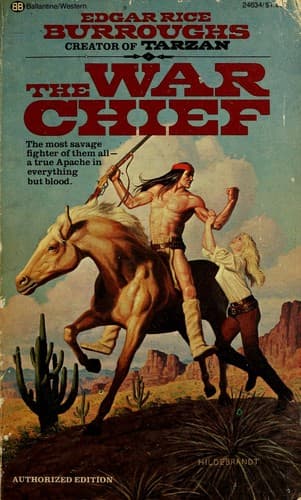
Apache Indians -- Fiction; Historical fiction; Western stories
The drums boomed, the dancers bent double, whirled about first upon one
foot and then upon the other. The men advanced, the girls retreated to
the outer edge of the dance ground. Among them, grotesque, painted,
decked out in the finery of their most gorgeous medicine headdress,
their finest izze-kloths, whirling their tzi-ditindes, the izze-nantans
whirled and leaped and danced, sprinkling the sacred hoddentin upon the
youths and maidens.
Nakay-do-klunni was there with Nan-ta-do-tash and many another famous
medicine man of the six tribes of the Apaches, speaking volumes for the
wealth and power of the father of little Ish-kay-nay. Now the men
retreated, backing toward the fire, and the girls advanced, and thus,
forward and back, they danced for hours, chanting the sacred songs of
their people, doing honor to Ish-kay-nay.
And all the time the girl remained in the great lodge, taking no part in
the festivities and catching but an occasional glimpse of what was going
on without. At the end of the fourth night the food was gone, the mescal
and the tizwin had been consumed, the dancers were exhausted and the six
tribes repaired to their several camps to sleep off the effects of their
prolonged orgy. On the following day Ish-kay-nay’s eyebrows were
carefully plucked—the last official symbol of her emergence from
childhood to the marriage market. A month later her eye lashes would be
pulled out.
Shoz-Dijiji was not happy. He had had no part in the festivities, other
than a free hand at the food, and he had tried to smoke—with dire
results. This he might have done long before, having killed big game and
won the right to smoke like a grown man; but he had not cared to until
recently. Seeing Ish-kay-nay stepping suddenly from childhood to
womanhood had awakened within him, or rather had stimulated within him
an already overwhelming desire to appear mature.
From the tepee of Geronimo he had taken a few leaves of tobacco and
these he rolled in the dried leaf of an oak. With an ember from a camp
fire he lighted his primitive cigarette, and for several minutes he
derived great satisfaction from parading nonchalantly about, puffing
clouds of smoke to the moon; but shortly he crawled away out of sight
and lay down behind a bush. For a while he was quite helpless, but
presently he was able to unwrap his tzi-daltai, and to it he prayed that
the bad spirit that had entered his stomach with the smoke be driven
out. He prayed for a long time, until he fell asleep; and when he awoke
he knew that his medicine was strong medicine, for the sickness was
gone, leaving him only a little weak and a bit wabbly upon his feet.
Public-domain text, read in full here on John Shaqi.
Reviews
Reviews
No reviews yet
Be the first to share your thoughts on this work.
Join the Discussion
Join the discussion
Sign in to leave a comment or review.
Sign InorCreate an account