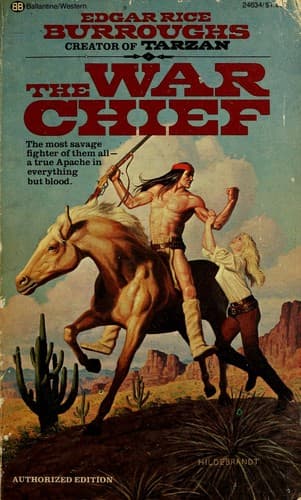
Apache Indians -- Fiction; Historical fiction; Western stories
The two chiefs rode together, exchanging occasional monosyllables, but
for the greater part of the time in silence. Shoz-Dijiji took the
station befitting a youth among warriors and rode in the rear and the
dust. At the edge of town the party was met by soldiers, two companies
of scouts, and before Geronimo or Victorio could realize their
intentions the party was surrounded, disarmed and arrested. Surprised,
chagrined and angry the Apaches were conducted to military headquarters,
and for the first time Shoz-Dijiji came into close contact with the
pindah lickoyee.
Closely surrounded by armed soldiers the Apaches were herded into a tent
where several officers were seated behind two camp tables. Ignoring his
guards Geronimo strode forward and faced the officers across the tables.
“Why have the soldiers done this to Geronimo and his friends?” he
demanded. “You sent for Geronimo as a friend and he came as a friend. Is
this the way to treat a friend?”
The senior officer turned to a Mexican standing near him. “What does he
say?” he demanded.
The Mexican, in turn, addressed a half-breed squatting at his side.
“What does he say?” he asked in Spanish. The half-breed translated
Geronimo’s words into Spanish and the Mexican translated them into
English for the senior officer.
“Tell him it is because he left Apache Pass without permission,” replied
the officer. “Ask him why he did this,” and again the Mexican translated
the officer’s words into Spanish and the half-breed translated them from
Spanish to Apache. Thus the entire proceedings were carried out. Perhaps
the translations were accurate—perhaps not. At any rate the principals
in the matter did not know.
Geronimo mused over the question before he replied. Then he addressed
himself directly to the senior officer, ignoring the interpreters. “I do
not think that I ever belonged to those soldiers at Apache Pass,” he
said, “or that I should have asked them where I might go. This is my
country. I have lived here all my life. It is the country that Usen gave
to the Apaches when he created them. It has always belonged to us. Why
should we ask the soldiers of the white-eyes for permission to go from
one part of our own country to another part?
“We have tried to live in peace with the white-eyes. We even tried to
stay at Apache Pass when they asked us to do so; but the white-eyes do
not know the ways of the Apaches as do the chiefs of the Apaches. They
did not know what they asked. The six tribes of the Apaches cannot all
live together in peace. The young men quarrel. This we knew would
happen, yet we tried to live together because we were told that it was
the wish of the Great White Chief.
“Some of the young men got drunk on whiskey that was sold to them by a
white-eyed man. They fought and some were killed. We, who are the chiefs
of our people, we, who are responsible for their welfare and happiness,
held a council and there we all agreed that the tribes could no longer
live in peace together.
Public-domain text, read in full here on John Shaqi.
Reviews
Reviews
No reviews yet
Be the first to share your thoughts on this work.
Join the Discussion
Join the discussion
Sign in to leave a comment or review.
Sign InorCreate an account