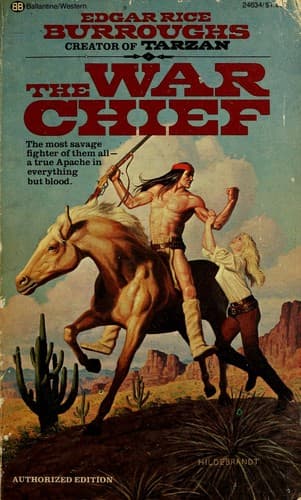
Apache Indians -- Fiction; Historical fiction; Western stories
One of his fellows called him to the opposite side of the wagon, where
Annie lay, and pointed to the dead woman’s sun-tanned face and straight,
black hair, and the high cheek bones that her Cherokee grandsire had
bequeathed her.
“Indian,” he said to Go-yat-thlay.
The war chief nodded.
A second Indian emerged from the wagon, where he had been rummaging. He
was grinning broadly. By one foot he held up for their inspection wee
Andy MacDuff, whom he was about to swing heavily against the nearest
iron tire when Go-yat-thlay stopped him with a gesture and holding out
his hand received the descendant of one, long dead, who had been equally
as savage as he. From northwestern Canada and from the Grampian Hills
the seeds had met at last.
Wee Andy had seemingly inherited, through his mother, more Indian blood
than flowed in her veins; at least he looked more an Indian than she,
with his round face, his big, dark eyes, his straight, black hair.
Go-yat-thlay thought him an Indian; upon no other hypothesis can be
explained the fact that instead of destroying him the savage chief
carried him back to the hogans of his own people, notwithstanding the
grumblings of Juh, who had wished to brain the spawn of the pindah
lickoyee.
Thus, in the dome-shaped, thatched brush hut of Go-yat-thlay, in the
arms of Sons-ee-ah-ray, his youngest squaw, ended the life history of
Andy MacDuff and began that of a nameless, little Indian baby.
That night to the camp of the Be-don-ko-he and the Ned-ni came a runner
from the headwaters of the Rio Mimbres. For over a hundred miles he had
come on foot, across parched desert burning beneath the fiery rays of
Chigo-na-ay, and over rugged mountains that no horse could travel, in
sixteen hours.
Moccasins, of heavy buckskin with the toes turned up at right angles and
terminating in a disc an inch and a quarter in diameter that formed a
part of the rawhide sole, protected his feet and legs from the sharp
stones and the cactus; a narrow head band of Apache-tanned doeskin kept
his long, black hair from falling across his eyes; these and a G-string
were his apparel. Some parched corn and dried meat that he had carried
he had eaten on the way and he had drunk a little water from a bottle
improvised from a piece of the large intestine of a horse. The only
weapon that he carried was a knife.
His body glistening in the firelight, he stood before the warriors who
had quickly gathered at his coming. He glanced about the circle of grim
faces surrounding him. His eyes, passing over the features of Juh, Chief
of the Ned-ni, and Mangas, the eighteen-year-old son of the chief of the
Be-don-ko-he, stopped at last upon those of Go-yat-thlay, the Yawner.
“Bi-er-le the Cho-kon-en bring bad news to the Be-don-ko-he,” he
announced; “from Fort McLane he brings word that Mangas Colorado, Chief
of the Be-don-ko-he, is dead.”
Public-domain text, read in full here on John Shaqi.
Reviews
Reviews
No reviews yet
Be the first to share your thoughts on this work.
Join the Discussion
Join the discussion
Sign in to leave a comment or review.
Sign InorCreate an account