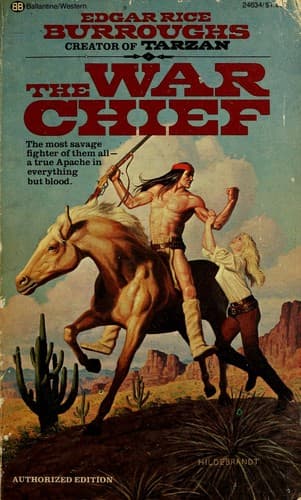
Apache Indians -- Fiction; Historical fiction; Western stories
After he had resumed his seat there was silence around the council fire
for several minutes. Then Geronimo arose. In his heart was murder, but
in his cruel features, schooled to obey his will, there was no hint of
it.
“Juh, Chief of the Ned-ni, knows that a single voice raised against
Shoz-Dijiji now will prevent him from being admitted to the warrior
class until he has undergone another trial upon the war trail. Geronimo
knows that the words of Juh are not prompted by loyalty to the
Shis-Inday as much as they are by hatred of Shoz-Dijiji. This is not the
act of a brave warrior or a great chief. Such things bring strife among
the Shis-Inday. Does Juh wish to change his words before it is too
late?”
The chief of the Ned-ni sprang to his feet. “Juh has spoken,” he cried.
“Juh does not change his words. Let Shoz-Dijiji change his ways to the
ways of a warrior and Juh will, perhaps, speak differently at another
council.”
“The laws of the Shis-Inday were made by Usen,” said Geronimo, “and they
may not be lightly changed. The words have been spoken and not recalled.
Shoz-Dijiji must go again upon the war trail and prove himself once
again fit to become a warrior. I, Geronimo, war chief of the Apaches say
these words.” He sat down.
However keen the disappointment of Shoz-Dijiji when he was told of the
action of the council, he received the information with the stolid
indifference of an Indian, though within his breast the fires of his
hatred for Juh burned with renewed fury. Ish-kay-nay, understanding,
spoke words of praise and comfort, and Gian-nah-tah applied vile,
obscene Apache epithets to the great chief Juh—when he was sure that no
Ned-ni might overhear him.
Ish-kay-nay had a suggestion to make. “Upon the next raid, Shoz-Dijiji,”
she advised, “do not kill. Torture the living, mutilate the dead. Show
them that your heart is strong.”
“Never!” exclaimed Shoz-Dijiji. “If for no other reason, because Juh
wishes me to, I will not do it.”
“Why do you not torture?” asked Ish-kay-nay. “You are brave—everyone
knows that—so it cannot be that you are afraid.”
“I see no sense in it,” replied the young brave. “It gives me no
pleasure.” He paused. “Ish-kay-nay, I cannot explain why it is and I
have never told any one before, but when I see warriors torturing the
helpless wounded and the defenseless prisoner, mutilating dead men who
have fought bravely, something comes into my heart which is not pride of
my people. I am ashamed, Ish-kay-nay, of even my own father, Geronimo.
“I do not know why. I only know that I speak true words without
understanding them. I know that I am no coward; but I should not be so
sure of that had I plunged a red-hot king bolt into a screaming white
woman, as I have seen Juh do, and laughed at her agonies of death.”
“If you feel pity for the enemy you are weak,” said Ish-kay-nay,
sternly.
Public-domain text, read in full here on John Shaqi.
Reviews
Reviews
No reviews yet
Be the first to share your thoughts on this work.
Elsewhere in the archive
Join the Discussion
Join the discussion
Sign in to leave a comment or review.
Sign InorCreate an account