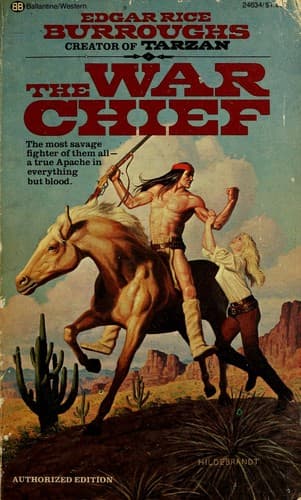
Apache Indians -- Fiction; Historical fiction; Western stories
“I do not feel pity,” replied Shoz-Dijiji. “I care not how much they
suffer. I only know that it gives me no pleasure to watch them and that
I do not think that it shows bravery to raise a weapon against any
creature which cannot inflict harm upon you in return, except in the
chase, where any man may kill for food.”
“Perhaps Shoz-Dijiji is right,” said Ish-kay-nay. “I had never thought
of it in this way before.”
“I know I am right, and I shall not torture if I never become a
warrior!”
But he had not a great while to wait before his chance came. Living, as
the Apache did, in constant danger of attack by the soldiers of two
civilized powers as well as by raiding parties of hostile Indian tribes,
he found it expedient, in the interest of survival, to maintain
constant, unflagging watchfulness. To this end Geronimo, however safely
he might consider his village hidden, kept scouts almost constantly in
the field.
To this duty, one in which he delighted, Shoz-Dijiji was often detailed.
It sent him alone into the solitudes that he loved, to play in stern
reality the games of his childhood. It kept him always hard and fit for
the war trail—the ultimate hope and ambition of the warrior. It
practiced him continually in the wood and plain craft in which he
already excelled.
Sometimes, astride Nejeunee, he covered prodigious distances in a day,
but oftener, on foot, he also covered prodigious distances. Forty,
fifty, at times a hundred miles of barren land would unroll beneath his
steady jog in a single day. His great lungs pushed out his giant chest.
The muscles of his mighty legs might, it almost seemed, turn a bullet,
so hard were they. He was a man now, by the standards of the Apache,
except for the fact that he had not yet been admitted to the warrior
class.
Among the Be-don-ko-he he was looked upon with respect and admiration,
for they knew that it was only the hatred of Juh that prevented him from
being a warrior. Upon the war trail and in the chase he had proved
himself all that a warrior should be and he carried himself with the
restraint and dignity of a chief. Ish-kay-nay was very proud of him, for
it was no secret in the tribe that when Shoz-Dijiji became a warrior his
pony would be tied before her tepee, nor was there one who believed that
she would wait the full four days before leading it to water and feeding
it.
Afoot, fifty miles from camp, Shoz-Dijiji was scouting. A few miles
ahead in the hills there was water and toward this he was making his way
one mid-afternoon. A blistering sun poured down upon him, the
superheated earth and rocks of the trail gave it back in searing
intensity. The country he had crossed had been entirely waterless, and
so it was that Shoz-Dijiji looked forward to the little spring hidden in
these seemingly arid hills, a spring known only to his people, sacred to
the Apaches.
Public-domain text, read in full here on John Shaqi.
Reviews
Reviews
No reviews yet
Be the first to share your thoughts on this work.
Elsewhere in the archive
Join the Discussion
Join the discussion
Sign in to leave a comment or review.
Sign InorCreate an account