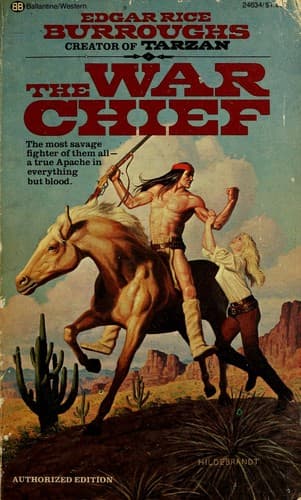
Apache Indians -- Fiction; Historical fiction; Western stories
Upon that raid, in 1864, the Be-don-ko-he brought back live cattle for
the first time; but it was gruelling work, caring for the wounded and
keeping the cattle from straying, for the Apaches were on foot; so the
following year Go-yat-thlay organized a mounted raid into Sonora; but
this time the women and children were left at home. However, Wee Andy
was busy learning to walk, so he did not care.
CHAPTER II
SHOZ-DIJIJI
THE years rolled by—happy, exciting years for the little boy, whether
sitting at the feet of Morning Star listening to the legends of their
people, or learning of the ways of the sun and the moon and the stars
and the storms, or praying to Usen for health, for strength, for wisdom,
or for protection, or being hurried to safety when enemies attacked. The
chase, the battle, the wild dances, fierce oaths, loving care, savage
cruelties, deep friendships, hatred, vengeance, the lust for loot,
hardship—bitter, bitter hardship—a little ease; these were the
influences that shaped the character of the growing boy.
Go-yat-thlay told him of the deeds of his forefathers—of Maco, the
grandfather of Go-yat-thlay, who had been a great warrior and hereditary
chief of the Ned-ni; of Delgadito and of Mangas Colorado. He taught him
how to make and use the bow and the arrow and the lance, and from fierce
and terrible Go-yat-thlay, who was never fierce or terrible to him, he
learned that it was his duty to kill the enemies of his people—to hate
them, to torture them, to kill them—and that of all the enemies of the
Shis-Inday the Mexicans were the most to be hated, and next to the
Mexicans, the Americans.
At eight the boy was more proficient at trailing and hunting than a
white man ever becomes, nor was he any mean marksman with his primitive
weapons. Already he was longing to become a warrior. Often, while
Go-yat-thlay talked to him, he sat and fondled the Spencer rifle that
the chief had taken from a dead soldier, his fingers itching to press
the trigger as he dropped the sights upon a soldier of the white-eyes.
It was in the spring of 1873 that a boy of ten, armed with bow and
arrows, moved silently up a timbered canyon along the headwaters of the
Gila. He was almost naked, but for loin cloth and moccasins. A strip of
soft buckskin, which the loving hands of Sons-ee-ah-ray had made
beautiful with colored beads, bound his brow and his straight, black
hair. In a quiver of mountain lion skin he carried his arrows behind his
left shoulder. He was tall for his age and very straight, his skin was
reddish-brown and of that wondrous texture that belongs alone to the
skin of healthy childhood; his movements were all grace, like those of a
panther.
Public-domain text, read in full here on John Shaqi.
Reviews
Reviews
No reviews yet
Be the first to share your thoughts on this work.
Join the Discussion
Join the discussion
Sign in to leave a comment or review.
Sign InorCreate an account