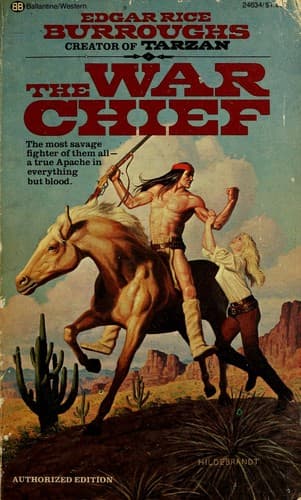
Apache Indians -- Fiction; Historical fiction; Western stories
He and his people had seen the pindah lickoyee “discover” their hidden
springs and water holes many times before in the past. In ones or twos
or threes the white-eyed men had stumbled upon these gifts of Usen to
his people in the arid places, and presently a trail was beaten to them
and many of the white-eyed ones came, and the birds and the game were
frightened away. Often a fence was built around the water and a white
man with bushy whiskers, and dirt in his ears, guarded it, a rifle in
one hand, a bottle of whiskey in the other, making other white men pay
for the water, keeping the Indians away from it entirely.
Warriors of the Be-don-ko-he, fathers of his playmates, had been shot by
such men when they had sought to quench their thirst at springs from
which they had drunk since childhood, and that their fathers had used
before them beyond the memory of man. Such were the thoughts that filled
the heart of Shoz-Dijiji as he crept toward the summit of the hill that
hid the usurpers from his view.
At last his eyes looked down upon the scene beyond, burning pits of hate
in which there lived no slightest spark of aught but loathing and
contempt. The Comanche, the Navajo, the bear, the snake might awaken
admiration in the breast of the Apache, but the white man, never!
He saw three bearded men sprawled upon the ground. One of them was
frying bacon above a small fire. Two burros, thin, dejected, stood with
drooping heads. A third was stretched upon the ground, exhausted. Their
packs lay in disorder all about. The men appeared to be weak.
Shoz-Dijiji read their story at a glance.
Lost in this waterless wasteland, they had found the spring by accident
just in time to save themselves from death. He noted their sunken cheeks
and eyes; he saw their feeble movements. But there was no answering pity
in his heart. In his mind, however, there arose vividly the recollection
of a white soldier wantonly hurling him to the ground, and of his words,
the meaning of which he had learned at San Carlos: “What the hell are
you doing here, you dirty Siwash?” A shudder ran through the frame of
Shoz-Dijiji then, as it always did at recollection of the humiliation of
that moment at Hot Springs.
He noted carefully every detail of the scene below him. He saw that the
men, with scarce the strength to carry their own weight, had transferred
everything to the packs of the burros, even including their rifles and
revolvers, and these lay now at a little distance from them, entangled
in the piles of carelessly down-thrown tools, bedding and provisions
that go to make up the outfits of prospectors.
Public-domain text, read in full here on John Shaqi.
Reviews
Reviews
No reviews yet
Be the first to share your thoughts on this work.
Elsewhere in the archive
Join the Discussion
Join the discussion
Sign in to leave a comment or review.
Sign InorCreate an account