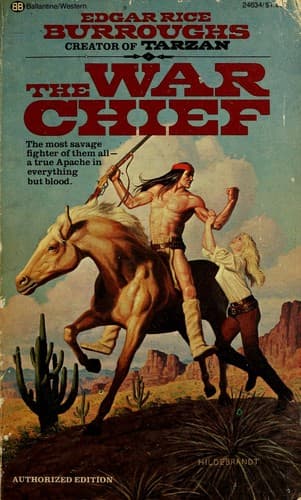
Apache Indians -- Fiction; Historical fiction; Western stories
Suddenly there was wafted to the Indian’s nostrils the faintest
suggestion of an acrid odor and simultaneously he vanished from the
landscape, so quickly did he react to this tenuous hint of danger. A
greasewood hid him from the direction down which a barely moving current
of air had wafted this certain indication of the presence of man. From
straight ahead it came, from the direction in which he was going. Where
there was smoke there was man and man would not be making a fire in this
vicinity elsewhere than beside the water where Shoz-Dijiji was planning
to quench his thirst.
From beneath the greasewood his keen eyes looked out toward the low hill
behind which lay the water, and now he saw thin smoke arising. So little
was the smoke that Shoz-Dijiji almost felt that it had been made by
Indians, yet, too, he knew that near the water there was little
wherewith to make a fire, and so, perchance, the pindah lickoyee, who
ordinarily make great fires, foolishly, had been forced to make a small
fire from want of fuel. Therefore he could not be sure whether Indians
or whites were concealed behind that little hill. If they were the
former, and Apaches, well and good, but if they were not, then they were
enemies, for every man’s hand is against the Apache.
Shoz-Dijiji, with the patience that is only an Indian’s, lay silent,
motionless for hours. As he lay he broke branches from the greasewood,
which chanced to be an unusually large bush, until at last he had
gathered enough to form quite a respectable screen. Then, having seen or
heard no further signs of life from beyond the hill, he crawled forward
a few inches, keeping the screen before him. Again he lay motionless for
a while, watching, before he advanced a short distance.
This he kept up for a full hour, during which he had covered the
distance to the foot of the hill and up its slope almost to the summit.
Now he could hear voices, and they told him that he was approaching the
camp of white men—three of them.
Shoz-Dijiji felt the heat of just anger surge through him. What right
had these aliens at the water hole of the Shis-Inday? For a thousand
thousand years had this spring been hidden away from the sight of man,
just where Usen had placed it for the use of the six tribes. That three
white-eyed men should camp beside it, quench their thirst, cook their
food, sleep and move on, aroused, of itself, no resentment in the heart
of Shoz-Dijiji; it was the foregone conclusion of the aftermath that
caused his apprehension and his determination to prevent the natural
sequences of this event.
Public-domain text, read in full here on John Shaqi.
Reviews
Reviews
No reviews yet
Be the first to share your thoughts on this work.
Elsewhere in the archive
Join the Discussion
Join the discussion
Sign in to leave a comment or review.
Sign InorCreate an account