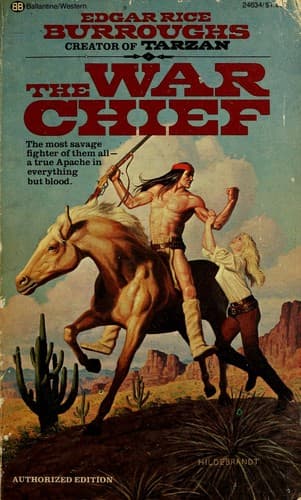
Apache Indians -- Fiction; Historical fiction; Western stories
Geronimo nodded. “Go,” he said, “and take Gian-nah-tah with you. He can
help.” So that very night Shoz-Dijiji and Gian-nah-tah set out upon
their ponies with two led animals upon which to pack the loot; and
Geronimo said to Victorio: “Shoz-Dijiji took the war trail and slew
three of the enemies of his people. If he returns with loot he has
proved that he is fit to be a warrior. We will hold a council and vote
again.”
“Yes,” agreed Victorio, “if he returns with many presents we will make
him a warrior. Juh is not here.”
Three days later Shoz-Dijiji and Gian-nah-tah returned. The former
turned over all the loot, except one rifle, a revolver and ammunition
for himself, to Geronimo to distribute, announcing that he was going
that very night to the high places to pray to Usen, to make big medicine
and to prepare himself to become a warrior. His words and manner carried
a definite inference that he fully expected to be admitted to the
council of warriors before he returned. Geronimo laid his hand upon the
shoulder of his son and there were both pride and affection in the
gesture.
“When Shoz-Dijiji returns from the high places,” he said, “he will be a
warrior, or there will be a new chief of the Be-don-ko-he, for Geronimo
will be dead.”
But Geronimo did not die, and when Shoz-Dijiji returned after two days
of prayer he found himself a warrior. The first great ambition of his
life was achieved and now the road lay clear to any heights to which he
might aspire. He was his own master, free to go and come as inclination
prompted.
He could take a squaw, or as many of them as he could afford. Though he
had but three ponies, which were scarcely enough to compensate any fond
father for the loss of the least attractive of daughters, he was in no
way down-hearted. The girl of his choice would unquestionably command
several times three ponies, but Shoz-Dijiji knew that he would win her
and he was happy. He had no thought in his heart for any other mate.
Ish-kay-nay would never have a rival in the affections of Shoz-Dijiji.
Unquestionably he would take other squaws as the years passed, thus
lightening the domestic burdens of Ish-kay-nay, since nothing less could
be expected of an important and prosperous warrior who had a name and
dignity to uphold. Ish-kay-nay would expect at least this much
consideration, and she would be ashamed if he proved too poor a provider
or too penurious a mate to support an establishment commensurate with
the social standing of her family and his; but that would come later—at
first they would be alone.
Shoz-Dijiji had not seen Ish-kay-nay alone for a long time, but tonight
he found her and together they wandered into the forest and sat upon the
bole of a fallen tree. He held one of her hands in his and putting an
arm about her slim, young shoulders he drew her to him.
“My father is very angry,” confided Ish-kay-nay.
“Why?” asked Shoz-Dijiji.
“Because I did not feed and water the pony of Juh, chief of the Ned-ni.”
Public-domain text, read in full here on John Shaqi.
Reviews
Reviews
No reviews yet
Be the first to share your thoughts on this work.
Elsewhere in the archive
Join the Discussion
Join the discussion
Sign in to leave a comment or review.
Sign InorCreate an account