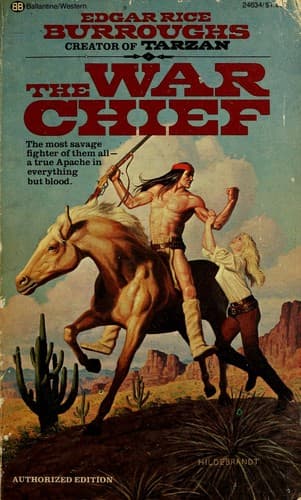
Apache Indians -- Fiction; Historical fiction; Western stories
Upon his legs Shoz-Dijiji drew his long war moccasins with their rawhide
soles and protecting toe armor, their tops, three feet long, he turned
down from just below the knee, thus still further protecting the lower
leg from the sharp spines of the cactus. Slender thongs of buckskin,
leading from the moccasin tops to the belt of his loin cloth, kept the
former from falling down around his ankles. A pair of cotton drawers
encased his legs and a quiet-hued print shirt covered his torso, its
skirts falling outside the drawers. There was a cartridge belt around
his waist and a six-shooter and a butcher knife at his hips, but he also
carried his beloved bow and arrows as well as the rifle he had taken
from the white prospector.
Shoz-Dijiji preferred the nakedness of a single loin cloth, for thus it
had been his wont to go in all weathers since he wore anything at all,
but custom seemed to demand these other things of full fledged warriors,
though all were accustomed to discard them upon the eve of battle, and
as he had just attained the status of the warrior class he felt it
incumbent upon him to uphold its traditions even to the point of making
himself supremely uncomfortable in hated shirt and drawers. However, the
party had been upon the trail but a short time before he discovered that
the drawers wrinkled and chafed him and they were discarded with no
regrets; and later in the day he removed his shirt and gave it to
Gian-nah-tah.
“It makes me look like a pindah lickoyee,” he confided to his friend.
“In it I do not feel free. I shall not wear it.”
His bronzed hide, naked to the elements almost from birth, little felt
the hot rays of the sun, thus eliminating the only practical reason why
an Apache should wear a shirt at all. Thus Shoz-Dijiji rode almost
naked—except for moccasins, G-string and head-bandanna he was quite
naked. Beneath his bandanna he wore the war band about his brow
confining his black hair, slicked smooth with tallow. It was not long
after the shirt went that he removed the bandanna, breathing a sigh of
relief, for now Shoz-Dijiji was himself again.
Before dawn the party had separated, the braves, in pairs, moving at
right angles to their original line of march, and in both directions,
forming at last a thin line of scouts that surveyed from hidden vantage
spots a front of sixty miles extending east and west across the lines
the troops would naturally follow as they marched down from San Carlos.
Signals had been arranged and the rendezvous designated by the sub-chief
in command. The braves were to proceed as quickly as possible to certain
advantageous positions indicated by the sub-chief. There they were to
remain until they sighted troops, or received the signal that other
scouts had sighted them. They were to stay concealed and, if possible,
avoid battle.
Public-domain text, read in full here on John Shaqi.
Reviews
Reviews
No reviews yet
Be the first to share your thoughts on this work.
Elsewhere in the archive
Join the Discussion
Join the discussion
Sign in to leave a comment or review.
Sign InorCreate an account