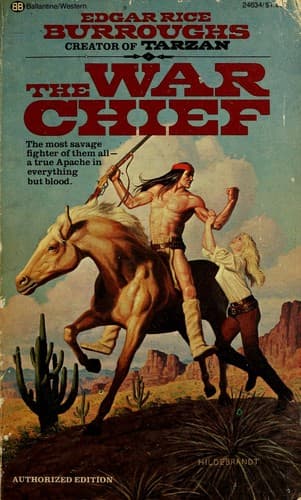
Apache Indians -- Fiction; Historical fiction; Western stories
The girl threw her head up haughtily. “No one will dare say that of
Ish-kay-nay,” she cried fiercely. “Nor will anyone think it. Does not
every one know that I can have Juh, or any of a dozen of the bravest
warriors of the Be-don-ko-he, Cho-kon-en, the Ned-ni or the Chi-hen-ne?
Is it any secret that Shoz-Dijiji loves me, or that I love Shoz-Dijiji?
Such foolishness is for fools.”
“Ish-kay-nay will be the mother of war chiefs,” said Shoz-Dijiji
proudly.
“And Shoz-Dijiji will be their father,” replied the girl.
CHAPTER X
WICHITA BILLINGS
WHEN morning dawned it did not find Nejeunee tied before the tepee of
Ish-kay-nay, for the pinto stallion was far away upon the war trail with
his savage master. Word had come to Geronimo, even while Shoz-Dijiji and
Ish-kay-nay were making love in the woods, that troops from San Carlos
were looking for him, the bodies of the three prospectors having been
discovered by two Navajo scouts in the employ of the government.
Immediately the peaceful camp of the Be-don-ko-he became the scene of
hurried preparation for flight and for the war trail. A scouting party
of a dozen braves was dispatched in the direction from which the troops
might be expected, to watch and report their movements; if necessary, to
hold them in check while the main body of the Be-don-ko-he, with their
women, their children, their pony herd and their camp equipment made
good their escape across the line into Mexico.
Hurriedly were war bands adjusted, grim faces streaked with pigment,
weapons looked to, ponies caught and bridled. For the first time as a
warrior Shoz-Dijiji prepared for the war trail. Across his swart face,
from ear to ear, he painted a broad band of vermilion, laying on the
pigment boldly with the index finger of his right hand, stooping low
toward the light of a little fire, his features reflected in a small
round mirror held in his left hand. Above and below the vermilion band
he laid a coat of blue, the base of which was a ground micaceous stone.
A single necklace adorned his throat and two small silver rings were in
his ears.
Attached to his person and concealed from view was his tzi-daltai,
wrapped in a three-inch square of buckskin upon which were painted
crooked lines of red and yellow, depicting the red snake and the yellow.
This phylactery was in itself big medicine and very sacred; it added to
the potency of his tzi-daltai, rendering that amulet all-powerful. In
addition to the tzi-daltai the phylactery contained a bit of sacred
turquoise, and a tiny cross of lightning-riven pine, which Shoz-Dijiji
called intchi-dijin, the black wind. Upon these things no alien eye
might look without destroying their efficacy. For this reason the little
package was securely hidden in the folds of his loin cloth.
Public-domain text, read in full here on John Shaqi.
Reviews
Reviews
No reviews yet
Be the first to share your thoughts on this work.
Elsewhere in the archive
Join the Discussion
Join the discussion
Sign in to leave a comment or review.
Sign InorCreate an account