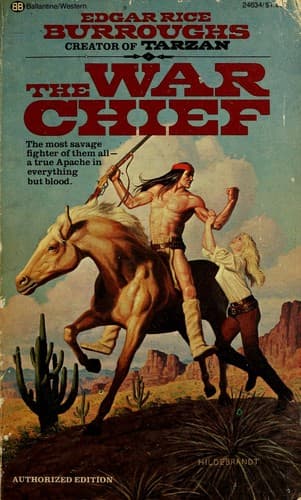
Apache Indians -- Fiction; Historical fiction; Western stories
A sinewy arm encircled the fellow’s neck and he was torn from his prey,
whirled about and thrown to the ground. Before he could recover himself
a hundred and seventy pounds of steel and iron fell savagely upon him,
his knife was wrested from his grasp and he shrieked once as his own
blade was buried deep in his heart.
Shoz-Dijiji sprang to his feet, saw the opening that had been made in
the enemy’s line, saw Gian-nah-tah and another fighting near him, called
them and broke through to the rear of the foe. Like a red demon he fell
upon the Mexicans and their henchmen; his savage war whoops rose above
the din of battle as with the clubbed rifle of an enemy he mowed them
down, while the very ferocity of his expression appeared to hold them in
a spell of awful fascination.
At last, splattered with the blood and brains of his adversaries, the
Black Bear paused. Erect in the midst of the carnage he had wrought he
stood like some avenging angel, his fierce eyes casting about for more
to slay. There were no more. To the last man the enemy lay dead upon the
field, dead or mortally wounded. Already the squaws were moving among
them. Shoz-Dijiji thought of the dying women, the mangled children at
the copper mines of Santa Rita, and the screams of the tortured brought
no answering pity to his heart.
Some warriors gathered about him. He suddenly became aware that they
were calling his name aloud; they were acclaiming him. It was unusual,
for more often does the Apache boast of his own exploits than those of
another; but there could be no mistaking. Geronimo came and laid a hand
upon his shoulder. “The warriors of the Be-don-ko-he have chosen
Shoz-Dijiji as a war chief,” he said, “and they have chosen well.”
Then the Black Bear understood. It had come! He thrilled, as what
red-blooded man would not thrill to be chosen a war chief by such
warriors as these! He had known that it would come—he had dreamed that
it was his destiny. This was the first step and it had come years before
he had hoped to achieve it. Shoz-Dijiji was very proud, but he was not
half as proud as terrible old Geronimo, or as little Ish-kay-nay.
That night moans and wails mingled with the exultations of the
victorious tribe, for twelve warriors had fallen in the battle. At the
council Shoz-Dijiji’s elevation to the rank of war chief was confirmed
amidst flights of oratory, and Gian-nah-tah was admitted to the warrior
class in recognition of his bravery upon the field of battle.
Their dead buried, the loot gathered from the bodies of the slain
foemen, the tribe packed its belongings and set out from this camp,
which they called Sko-la-ta, toward the northeast. Through the lofty
mountains they made their way, and when they came out down into Sonora
they were joined by Juh and a band of Ned-ni. The two tribes decided to
go to the town of Nacosari and trade with the Mexicans.
Public-domain text, read in full here on John Shaqi.
Reviews
Reviews
No reviews yet
Be the first to share your thoughts on this work.
Elsewhere in the archive
Join the Discussion
Join the discussion
Sign in to leave a comment or review.
Sign InorCreate an account