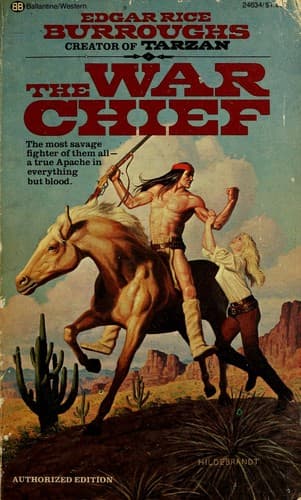
Apache Indians -- Fiction; Historical fiction; Western stories
On an open plain near Nacosari the Apaches were surprised by three
companies of Mexican troops, but, after the manner of Apaches when they
do not wish to give battle, they scattered in all directions and, firing
as they rode away, eluded concerted pursuit. When they had out-distanced
the troops they reassembled in the Sierra Madre and held a council. Juh
reported having seen Mexican troops at several points and Geronimo well
knew that they had been dispatched against him in Chihuahua. It was
therefore decided to disband as it would be impossible to maintain a
large camp secure from detection while an active campaign was in force
against them.
Scattering into single families or small groups of unmarried warriors,
they spread out through the mountains of Chihuahua, Sonora, New Mexico
and Arizona to await the withdrawal of the troops. For four months they
lived by hunting and trading, entering villages as friendly Indians,
always careful to commit no depredations, that the fears of the enemy
might be lulled into fancied security.
Shoz-Dijiji, happiest when farthest from the haunts of whites, spent all
his time hunting in the depth of the mountains. He was much alone, and
many were the long nights he spent in some rugged, granite aerie praying
to Usen and making strong medicine against future days of war. He
dreamed always of war or of Ish-kay-nay or of the goal of his
ambition—to be war chief of all the Apaches. The next step, as he
planned it, was to become head war chief of the Be-don-ko-he, after
Geronimo became too old to lead the tribe in battle, and after that he
would win to the final goal.
Occasionally he saw Mexicans in the mountains, and it amused him to
wonder what their reaction would be could they guess that a war chief of
the Apaches was lying behind a rock or bush above them looking down upon
them; but not one of them ever guessed that such potential death lurked
thus close.
On several occasions he ventured down upon the plains after antelope. On
one of these excursions he had approached a hacienda belonging to a very
rich Mexican who owned a herd of horses that was famed throughout all of
Mexico, and of which the owner was justly proud. Shoz-Dijiji often
watched this herd from a distance as it grazed under the watchful eyes
of numerous well-armed vaqueros. It interested him to note the care that
was exercised by day and by night to protect the herd against theft; it
pleased his vanity to guess that these precautions were directed by fear
of his people.
Public-domain text, read in full here on John Shaqi.
Reviews
Reviews
No reviews yet
Be the first to share your thoughts on this work.
Elsewhere in the archive
Join the Discussion
Join the discussion
Sign in to leave a comment or review.
Sign InorCreate an account