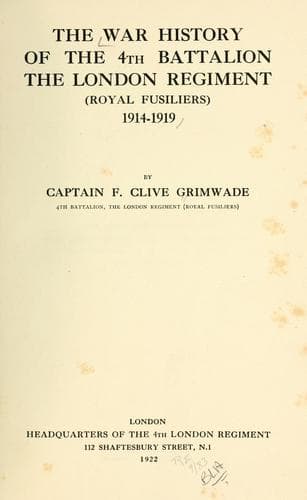
The War History of the 4th Battalion, the London Regiment (Royal Fusiliers), 1914-1919Grimwade, F. Clive
History
The War History of the 4th Battalion, the London Regiment (Royal Fusiliers), 1914-1919
Grimwade, F. Clive
Great Britain. Army. London Regiment. 4th (City of London) Battalion; World War, 1914-1918 -- Regimental histories -- Great Britain
Although the whole of the Battalions at Hurdcott and Fovant Camps
existed for the training of recruits and were in no way formations
which were likely to be sent overseas as units, they were included in
the scheme which had been prepared for the defence of Great Britain in
the event of an attempt at landing by the Germans.
This scheme provided for the maintenance of a permanent defence force
on the East Coast and at other points where it was deemed likely that
any attempt at invasion would be put into effect. In addition to this,
arrangements were made for the rapid concentration from other sources
of a mobile force for use, in the event of active operations taking
place, as a general reserve. To this general reserve the units of the
3rd line groups of the 1st London Division contributed a quota of
officers, N.C.O.'s and men varying from time to time with the numbers
of men who were sufficiently advanced in their course of training to
render their inclusion in the force useful.
During the period at Hurdcott frequent test concentrations took place,
in several instances the parade being followed by a test route march.
These parades were always attended by the platoons of the 4th (Reserve)
Battalion detailed for the time being to this duty and passed off
satisfactorily.
On the 2nd June 1916 Major W. H. Hamilton, who had commanded the
Battalion since its formation, was gazetted to the 4th Battalion Duke
of Cornwall's Light Infantry and almost immediately proceeded to join
his new Battalion at Meerut.[4] He was succeeded in temporary command
of the Battalion by Major G. H. M. Vine. On the occasion of Major
Hamilton's departure the troops testified to their appreciation of his
unfailing kindness and sympathy with all ranks throughout the period of
his command by lining the camp road and heartily cheering him as his
car passed down it.
[4] Major Hamilton remained with the 4th D.C.L.I. until the following
year when he was attached to the 4th Hants Regiment. With this
Battalion he proceeded to Mesopotamia and took part in the victorious
advance which culminated in the occupation of Baghdad. He was later
appointed to command the detachment of the Hants Regiment which
accompanied the gallant little force led by General Dunsterville to
endeavour to secure the oilfield of Baku on the Caspian Sea.
In the latter part of July command of the Battalion was assumed by Col.
Vickers Dunfee, Major Vine resuming the duties of second in command.
Public-domain text, read in full here on John Shaqi.
Reviews
Reviews
No reviews yet
Be the first to share your thoughts on this work.
Elsewhere in the archive
Join the Discussion
Join the discussion
Sign in to leave a comment or review.
Sign InorCreate an account