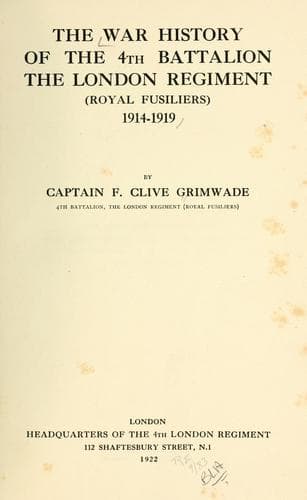
The War History of the 4th Battalion, the London Regiment (Royal Fusiliers), 1914-1919Grimwade, F. Clive
History
The War History of the 4th Battalion, the London Regiment (Royal Fusiliers), 1914-1919
Grimwade, F. Clive
Great Britain. Army. London Regiment. 4th (City of London) Battalion; World War, 1914-1918 -- Regimental histories -- Great Britain
The instructors themselves were drawn entirely from N.C.O.'s who had
served with the 1st or 2nd line battalions overseas, and had either
been invalided to the United Kingdom or were sent home for six months
"on exchange." In order to avoid staleness no instructor who was fit
for overseas service was permitted to retain his appointment for more
than one year, at the end of which period he himself returned to the
front as a reinforcement, his place on the training staff being taken
by one more recently returned to England.
Officer instructors were selected and retained on a similar principle,
the period of appointment to the establishment of a training reserve
unit being (in the case of physical fitness for service overseas) a
maximum of six months.
The officers of the first training staff appointed in the 4th (Reserve)
Battalion were:
Capt. F. C. Grimwade, in charge of training.
2/Lieut. E. G. Dew, Assistant to Training Officer.
2/Lieut. A. G. Croll;} Musketry Instructors.
" G. H. Hetley}
2/Lieut. R. K. Caparn, Physical Training Instructor.
2/Lieut. L. A. Allen, Lewis Gun "
2/Lieut. L. C. Haycraft, Bombing and Anti-gas "
Signalling instruction was provided under Brigade arrangements, the
first Brigade Signalling Officer, 2/Lieut. R. C. Hunt, being supplied
by the 4th (Reserve) Battalion.
Early in February 1916 the 4th (Reserve) Battalion received a very
welcome reinforcement in the shape of 50 men of the Second Trinidad
Contingent, and the honour done to the Regiment in selecting it for the
training of this draft, representative of one of the smallest and yet
most ancient and loyal outposts of the Empire, was much appreciated.
About the same time four Trinidad officers, 2/Lieuts. L. Farfan, H.
Dow, R. L. Fabien and J. MacDonald, were gazetted to the Battalion. It
was rapidly realised that the difference of climate between the West
Indies and the snow-laden winds of the "Plain" was too severe, and it
became evident that this keen and efficient platoon must be transferred
to a more suitable environment. After about six weeks with the 4th
(Reserve) Battalion, therefore, they were sent to complete their
training with the 7th Royal Fusiliers at Falmouth and later attached to
the 3/4th Devonshire Regiment in India.
In April Major H. J. Duncan-Teape rejoined the 1/4th Battalion in
France, the duties of second in command being assumed by Major G. H. M.
Vine.
During May the Battalion was inspected by Col. S. H. Godman, D.S.O.,
commanding the Division, who presented C. S. M. Risley, D.C.M., with
his medal. The Battalion also received a visit from Lieut.-Col. E.
T. Rodney Wilde, V.D. At the end of May the Division was reviewed by
Field-Marshal Earl French, commanding the Home Forces.
Public-domain text, read in full here on John Shaqi.
Reviews
Reviews
No reviews yet
Be the first to share your thoughts on this work.
Elsewhere in the archive
Join the Discussion
Join the discussion
Sign in to leave a comment or review.
Sign InorCreate an account