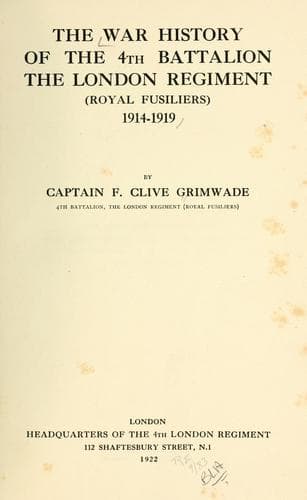
The War History of the 4th Battalion, the London Regiment (Royal Fusiliers), 1914-1919Grimwade, F. Clive
History
The War History of the 4th Battalion, the London Regiment (Royal Fusiliers), 1914-1919
Grimwade, F. Clive
Great Britain. Army. London Regiment. 4th (City of London) Battalion; World War, 1914-1918 -- Regimental histories -- Great Britain
It must be confessed that the immediate result of this amalgamation,
involving as it did the extinction as a separate entity of the 4th
(Reserve) Battalion, was a heavy blow to the _esprit de corps_ of all
ranks, which was in the circumstances at least comprehensible. The rank
and file at a critical stage of their training came under the command
of officers and N.C.O. instructors who were unknown to them, while the
instructors of the old 4th (Reserve) Battalion experienced a natural
and very keen disappointment at not being permitted to complete the
task to which they had applied themselves with such devotion for many
weeks past.
A closer acquaintance with the new surroundings, however, resulted in
a gradual disappearance of these feelings of regret, and in due course
a new _esprit de corps_ and a closer bond of union between the two
Regiments concerned took their place. At the end of its existence in
November 1918 the 3rd (Reserve) Battalion had become an extremely happy
one, in which no sort of distinction existed between the 3rd and 4th
London Regiments, and each worked for the welfare of all.
CHAPTER IX
THE FORMATION OF THE 56TH DIVISION
From May onwards during the remainder of 1916 the history of the
Regiment in France is that of the 1/4th Battalion, into which the
2/4th Battalion was merged; and we may therefore proceed to follow
its fortunes from the date of its attachment to the newly formed 56th
Division.
At the date of the 1/4th Battalion's arrival in billets at Citerne on
the 9th February 1916, the 56th Division was just being concentrated.
The 47th Division, which comprised chiefly battalions of the 2nd London
Division of pre-war days and which the Battalion had just left, had
joined the British Armies in France as a Division; but the units of the
old 1st London Division, which had been among the first Territorial
units to leave England, had hitherto been scattered throughout the Army
attached to different regular divisions. The 56th, therefore, though
junior in precedence, owing to its comparatively late formation, to
many other Territorial Divisions which had left England as complete
organisations, consisted entirely of battalions which might fairly be
described as veteran, since all had seen a good deal of stiff work up
and down the lines.
The infantry battalions were brigaded as follows:
56TH (LONDON) DIVISION--Major-Gen. Sir C. P. A. Hull, K.C.B.
167TH INFANTRY BRIGADE--Brig.-Gen. F. H. Burnell-Nugent, D.S.O.
1/1st London (Royal Fusiliers).
1/3rd London (Royal Fusiliers).
1/7th Middlesex.
1/8th Middlesex.
168TH INFANTRY BRIGADE--Brig.-Gen. G. G. Loch, C.M.G., D.S.O.
1/4th London (Royal Fusiliers).
1/12th London (Rangers).
1/13th London (Kensingtons).
1/14th London (London Scottish).
Public-domain text, read in full here on John Shaqi.
Reviews
Reviews
No reviews yet
Be the first to share your thoughts on this work.
Elsewhere in the archive
Join the Discussion
Join the discussion
Sign in to leave a comment or review.
Sign InorCreate an account