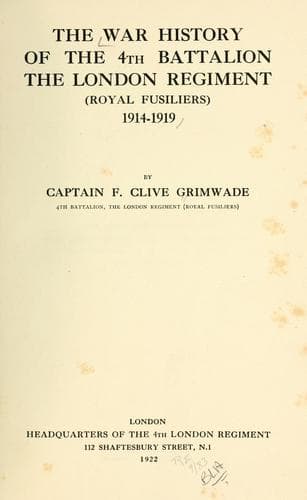
The War History of the 4th Battalion, the London Regiment (Royal Fusiliers), 1914-1919Grimwade, F. Clive
History
The War History of the 4th Battalion, the London Regiment (Royal Fusiliers), 1914-1919
Grimwade, F. Clive
Great Britain. Army. London Regiment. 4th (City of London) Battalion; World War, 1914-1918 -- Regimental histories -- Great Britain
169TH INFANTRY BRIGADE--Brig.-Gen. E. S. D'Ewes Coke, C.M.G., D.S.O.
1/2nd London (Royal Fusiliers).
1/5th London (London Rifle Brigade).
1/9th London (Queen Victoria Rifles).
1/16th London (Queen's Westminster Rifles).
The Division was attached to the VI Corps (Keir) of the Third Army
(Allenby).
The record of the next three months may be passed over quickly as
they were devoted solely to organising and training the new Division
in areas well to the rear of the trenches, and it was not until the
early days of May 1916 that the various units came under fire as a
Division. This prolonged period of rest, which indeed was the longest
ever spent in this manner by the Battalion in the whole course of
its active service history, was of considerable importance in order
that staffs and units might become thoroughly acquainted with each
other, and that the individual battalions of each Brigade might have
a sufficient opportunity of creating the divisional _esprit de corps_
which experience has shown to be so necessary in action.
But the three months of routine work will provide us with a useful
respite in which to make some reference to one or two developments in
organisation which were carried out before the British forces plunged
into the dreary and protracted struggles of the Somme, and which
affected the 1/4th Londons equally with other units.
One of the developments which took place about this period, and which
had an effect on the general efficiency of the Army so far-reaching
that its value can hardly be overestimated, was the formation of Army
and Divisional Schools, in which the lead was taken by the Third Army.
These schools, as is well known, were established under selected
bodies of instructors to achieve the double object of keeping the
fighting troops, through the medium of the regimental officers and
non-commissioned officers who attended them for short courses of
instruction, in touch with the progress made from time to time in the
art of war, and particularly in the more technical branches, such as
gas, bombing, Lewis gunnery, etc., and also of assisting battalions
to provide efficient courses of instruction and training for their own
personnel while out of the trenches for short periods. The success
which in general attended these efforts was great and their influence
on the action of our troops in the great battles of the latter part of
the War was undoubtedly far-reaching.
The 56th Divisional Schools were first established under Major D. V.
Smith, D.S.O., 1/1st Londons, at Givenchy-le-Noble and Ambrines in
April 1916.
Public-domain text, read in full here on John Shaqi.
Reviews
Reviews
No reviews yet
Be the first to share your thoughts on this work.
Elsewhere in the archive
Join the Discussion
Join the discussion
Sign in to leave a comment or review.
Sign InorCreate an account