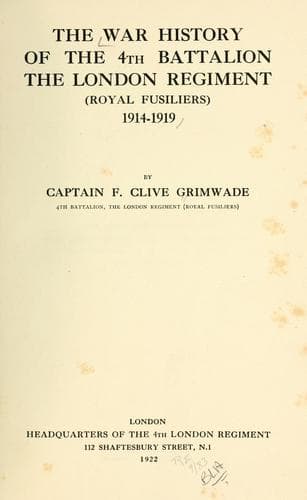
The War History of the 4th Battalion, the London Regiment (Royal Fusiliers), 1914-1919Grimwade, F. Clive
History
The War History of the 4th Battalion, the London Regiment (Royal Fusiliers), 1914-1919
Grimwade, F. Clive
Great Britain. Army. London Regiment. 4th (City of London) Battalion; World War, 1914-1918 -- Regimental histories -- Great Britain
Attention was also directed at this time towards training the
infantry to assume greater responsibility for the general maintenance
and strengthening of the forward trenches in their own occupation,
and thereby releasing the Royal Engineers for works requiring more
technical skill. To this end the early days of March saw the formation
in the Division of trench pioneer squads in each battalion consisting
of selected men under the supervision of a subaltern officer. These
squads were given special training in erecting wire entanglements,
constructing strong points and consolidation of newly captured
positions. The first trench pioneer officer of the 1/4th Londons was
2/Lieut. V. C. Donaldson, and under him the trench pioneers began to
shape well towards efficiency; but the need for the existence of such
squads was subsequently modified to some extent by the attachment to
each Division of a specially trained Pioneer Battalion, the 1/5th
Cheshire Regiment joining the 56th Division in this capacity. The
Pioneer Battalions were fighting units but, as their name implies, were
employed more particularly on constructional work rather beyond the
powers of the ordinary infantry officer to direct or of the troops to
execute, and in active operations their usefulness in consolidating
new trenches and similar duties was established beyond a doubt. The
advent of such highly trained units had a tendency somewhat, perhaps
not altogether rightly, to depreciate the value of battalion pioneer
squads, and ultimately these were done away with. The duty of trench
working parties, whether in active operations or in holding trenches,
afterwards fell equally on all the personnel of the companies, while
in the 56th Division if not in others, general direction was given to
the Battalion's activity in trench work by a "Works" officer attached
to Battalion Headquarters. This appointment established early in June
1916 was first filled in the 1/4th Londons by Capt. R. N. Arthur, and
remained in existence until the end of the War. The Works officer
became responsible for making arrangements between company commanders
and the Royal Engineers for the supply of the material required for the
trench work undertaken by the companies in the line, for detailing the
working parties supplied by the Battalion while out of the line, and in
general forming a link between the Commanding Officer and the company
commanders in the matter of trench work.
Public-domain text, read in full here on John Shaqi.
Reviews
Reviews
No reviews yet
Be the first to share your thoughts on this work.
Elsewhere in the archive
Join the Discussion
Join the discussion
Sign in to leave a comment or review.
Sign InorCreate an account