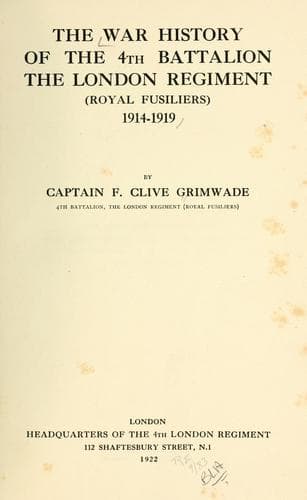
The War History of the 4th Battalion, the London Regiment (Royal Fusiliers), 1914-1919Grimwade, F. Clive
History
The War History of the 4th Battalion, the London Regiment (Royal Fusiliers), 1914-1919
Grimwade, F. Clive
Great Britain. Army. London Regiment. 4th (City of London) Battalion; World War, 1914-1918 -- Regimental histories -- Great Britain
Doullens did not provide a refuge to the Brigade for long for the 15th
March saw the Division once more on the move to the Le Cauroy area
(east of Frevent), the 1/4th Londons taking over billets at Beaufort.
In this area the Division settled down steadily to a period of training
which continued without interruption and with very little incident
calling for notice for nearly seven weeks, during which the strength
of the Battalion, as of all other units, gradually crept up, if not to
war strength at least to such size that it became abundantly evident
that the Division was not destined to remain for long in billets
behind the line. Drafts joined the Battalion consisting of 2/Lieuts.
G. E. Stanbridge, G. H. Davis and A. G. Blunn, and also of 87 other
ranks on the 22nd March; of 12 other ranks on the 6th April; and a
final reinforcement of 33 other ranks arrived on the 20th April; these
additions bringing the Battalion to the respectable strength of nearly
600 all ranks.
During the same period the Battalion suffered losses among officers
in Capt. J. R. Pyper, M.C., who was seconded to the 168th Brigade
Machine-Gun Company; Lieut. S. E. H. Walmisley, who after carrying out
the duties of Quartermaster for nearly four months during the absence
on sick leave of Lieut. E. S. Tomsett, was appointed to the Central
Training School, Rouen; and 2/Lieut. C. R. P. de Pury who was seconded
as R.T.O.
On the 23rd March Major W. G. Clark, D.S.O., left the Battalion on
short leave and he also succumbed to a severe breakdown while at home
and was unable to return. Command of the Battalion was carried on
temporarily by Major W. Moore until the 8th April, when Lieut.-Col. L.
L. Wheatley, D.S.O., Argyll and Sutherland Highlanders, Staff Captain
168th Infantry Brigade, took command.
It would be but tiresome to follow the daily routine of the Battalion
during this prolonged period of rest where one day's work so much
resembles that which preceded it, and we may therefore be forgiven for
passing quickly over this part of the record. Enough has been said to
show how from the Battalion point of view the Division came into being
and was prepared for the work allotted to it, and it remains therefore
for us to pass on and endeavour to recount the manner in which the
1/4th Londons performed their task.
CHAPTER X
THE 1/4TH BATTALION IN THE BATTLES OF THE SOMME, 1916
I. _The Attack on Gommecourt_
The spring of 1916 was marked by two enemy offensives, at Verdun and
on the Italian front, both of which tried the resources of our Allies
severely. In order to draw off German troops to the East the Russian
offensive against the Austrians had been started in May, but in spite
of this the German pressure against Verdun continued to increase.
Public-domain text, read in full here on John Shaqi.
Reviews
Reviews
No reviews yet
Be the first to share your thoughts on this work.
Elsewhere in the archive
Join the Discussion
Join the discussion
Sign in to leave a comment or review.
Sign InorCreate an account