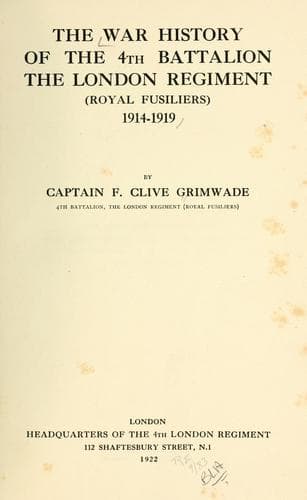
The War History of the 4th Battalion, the London Regiment (Royal Fusiliers), 1914-1919Grimwade, F. Clive
History
The War History of the 4th Battalion, the London Regiment (Royal Fusiliers), 1914-1919
Grimwade, F. Clive
Great Britain. Army. London Regiment. 4th (City of London) Battalion; World War, 1914-1918 -- Regimental histories -- Great Britain
Sir Douglas Haig had for some time intended to undertake an offensive
operation on a large scale during 1916 in conjunction with the French,
and in view of the continual increase in the strength of the British
Armies it was clearly desirable that the launching of the battle should
be delayed as long as possible consistent with the advance of the
summer. But in view of the great pressure at Verdun it was decided that
the British attacks should begin at the latest at the end of June, with
the objects of relieving our Allies and of pinning as many enemies as
possible to the front opposite the British Armies, in addition to the
tactical improvement of our positions.
The part of the enemy's lines selected for attack was the right of the
British front, opposite which the Germans occupied high ground forming
the watershed between the River Somme and the rivers flowing north-east
into Belgium. The general direction of this watershed, which consists
of a chalk country of broad swelling downs and deep well-wooded
valleys, is roughly from east-south-east to west-north-west. The aspect
of this country bears a general resemblance to parts of Wiltshire,
and the gentle undulations of the higher slopes of the hills, which
descend with unexpected abruptness into waterless valleys lined with
banks whose declivitous sides seem to have been shaped by human agency,
cause the resemblance to be one also of detail. From this watershed
a series of long spurs runs south-westerly towards the Somme, and on
their lower slopes the German lines ran from Curlu near the river at
first north and then almost due west to Fricourt, a distance of some
10,000 yards. At Fricourt the lines took an abrupt turn northward for
a further 10,000 yards when they crossed the Ancre, a tributary of
the Somme, near Hamel. From this point they continued in a generally
northerly direction, passing through Beaumont Hamel, west of Serre
and between Hébuterne and Gommecourt. In the neighbourhood of the two
last-named villages the lines crossed the summit of the main watershed,
and thence descended gently in a north-easterly direction towards Arras.
On the 20,000 yards between the Somme and the Ancre the enemy had
already prepared a strong second system of defence about two miles
in rear of the front system; and on the whole front from Gommecourt
to the Somme he had spared no effort in the nearly two years of his
uninterrupted occupation to render these positions impregnable.
The strengthening of woods and villages into fortresses, and the
skilful use of the ground in siting trenches and gun and machine-gun
emplacements, had in fact woven his successive lines of trenches
into one composite system. Yet further in rear he was still at work
improving existing defences and constructing new.
Public-domain text, read in full here on John Shaqi.
Reviews
Reviews
No reviews yet
Be the first to share your thoughts on this work.
Elsewhere in the archive
Join the Discussion
Join the discussion
Sign in to leave a comment or review.
Sign InorCreate an account