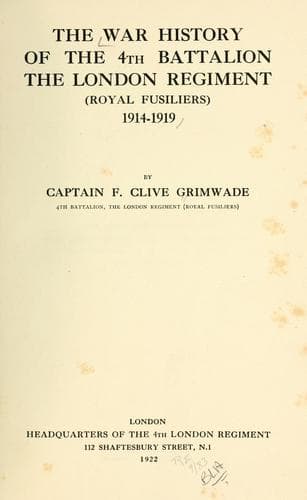
The War History of the 4th Battalion, the London Regiment (Royal Fusiliers), 1914-1919Grimwade, F. Clive
History
The War History of the 4th Battalion, the London Regiment (Royal Fusiliers), 1914-1919
Grimwade, F. Clive
Great Britain. Army. London Regiment. 4th (City of London) Battalion; World War, 1914-1918 -- Regimental histories -- Great Britain
The front of attack on which the British armies were to operate covered
the whole of the above described line from Gommecourt to Curlu--a total
of about 17 miles--while the French were to co-operate on a wide front
immediately south of the River Somme.
The story of the struggle which, lasting from the beginning of July
until the early part of November, gave us possession, first of the
forward trench systems, then of the crest of the ridge, and finally
of the whole plateau and parts of the further slopes, divides itself
into phases, which can be dealt with in turn to such an extent as the
record of the 1/4th Battalion is concerned with them. For the present
we are concerned with the enormous preparations which preceded the
opening of the struggle and of the first phase of the battle which
began on the 1st July 1916.
Dealing with the preparations for the battle generally, an enormous
amount of work was required in improving road and rail communications;
in digging assembly trenches and dugouts, for use not only as shelters
but also as aid posts and stores for ammunition for small arms and
trench mortars; and in constructing many additional machine-gun and gun
emplacements. The water supply for the assaulting troops presented a
serious problem, and Sir Douglas Haig records in his Despatches that in
this connection over a hundred pumping plants were installed and over
120 miles of water mains laid.
During most of the period in which this preliminary labour proceeded
the troops were working under most trying weather conditions and
frequently were harassed by heavy enemy fire.
The particular tasks for which the 168th Brigade, and in particular the
1/4th Londons, were called upon will be referred to in their places at
greater length.
* * * * *
After remaining in training in the Frevent area for the latter half of
March and the whole of April the 56th Division moved forward on the
3rd and 4th of May into the VII Corps area (D'Oyly Snow) and took over
from the 46th Division a sector of the line in front of the village of
Hébuterne and facing Gommecourt.
The line was occupied by the 167th Brigade, the 168th moving in reserve
to Souastre, a small village some three miles west of the front
trenches. The Battalion moved by march route from Beaufort on the 6th
and arrived at Souastre after a ten mile march at 9 p.m.
Two or three days were occupied in training, and on the 11th May the
Battalion began to supply working parties of considerable size. Of
these, one of 200 all ranks was despatched to Pas and employed in
felling and sawing trees to form props for gun pits and dugouts; and
another of 250 all ranks went to the chalk quarries of Hénu, where they
were given a task in digging road material. These working parties, the
first of many weary tasks, constituted so far as the Battalion was
concerned the first direct active preparations in the area of battle
for the Somme offensive.
Public-domain text, read in full here on John Shaqi.
Reviews
Reviews
No reviews yet
Be the first to share your thoughts on this work.
Elsewhere in the archive
Join the Discussion
Join the discussion
Sign in to leave a comment or review.
Sign InorCreate an account