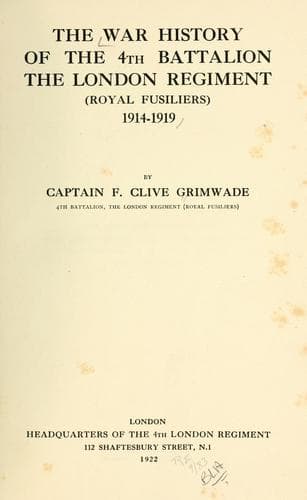
The War History of the 4th Battalion, the London Regiment (Royal Fusiliers), 1914-1919Grimwade, F. Clive
History
The War History of the 4th Battalion, the London Regiment (Royal Fusiliers), 1914-1919
Grimwade, F. Clive
Great Britain. Army. London Regiment. 4th (City of London) Battalion; World War, 1914-1918 -- Regimental histories -- Great Britain
On the 22nd the detachments in Hébuterne were relieved by C Company,
who took over their tasks. Each night of the period of duty in
Bayencourt the Battalion continued to supply large numbers of men for
fatigues of various sorts, the parties being small and divided amongst
a large number of tasks. These working parties were equipped as lightly
as possible, the men carrying water-bottles and respirators over the
left shoulder; a bandolier of fifty rounds over the right shoulder;
and their rifles with bayonet in scabbard fixed. But although the
troops moved "light" the duties were onerous, partly from the long
hours of work and the strain induced by the short available time in
which to complete apparently impossible tasks; and not least by the bad
weather, the season from the middle of May onwards being for the most
part wet. Hitherto practically no casualties had been sustained, the
first recorded casualties at the enemy's hands during the Battalion's
attachment to the 56th Division occurring on the 24th May, when two men
were wounded at work in Hébuterne.
On the afternoon of the 28th May the 1/4th Londons relieved the
Kensingtons in W subsector of the Divisional front, the Battalion still
being under the orders of the 169th Brigade. The Kensingtons took over
on relief the billets at Bayencourt.
The Divisional sector as taken over from the 46th Division early in
May had consisted of the original line taken up by the French troops
in October 1914 during the extension of the battle line from the Aisne
to the sea. This line the French had continued to hold until they
were finally relieved of responsibility for it in June 1915, when the
British extended their lines southward to the Somme. The frontage of
the sector extended as shown on Map No. 4 from the Bucquoy Road on
the right to a point opposite the most westerly point of Gommecourt
Wood on the left, being divided into two subsectors, W and Y, by an
imaginary line running roughly parallel to, and 200 yards north of, the
Hébuterne-Bucquoy Road. Opposite the British lines the Germans held a
position of enormous strength bastioned by the enclosure of Gommecourt
Wood which marked an abrupt salient in their line. As was only too
frequently the case the enemy possessed considerable advantages of
observation over the British lines, the ground rising steadily in rear
of his front trenches to the Gommecourt-Bucquoy ridge, which, although
not a hill of outstanding pre-eminence, formed the summit of the Somme
watershed described earlier in this chapter.
Public-domain text, read in full here on John Shaqi.
Reviews
Reviews
No reviews yet
Be the first to share your thoughts on this work.
Elsewhere in the archive
Join the Discussion
Join the discussion
Sign in to leave a comment or review.
Sign InorCreate an account