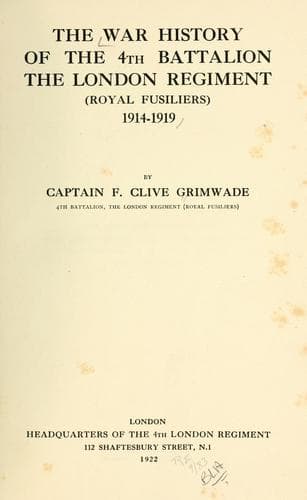
The War History of the 4th Battalion, the London Regiment (Royal Fusiliers), 1914-1919Grimwade, F. Clive
History
The War History of the 4th Battalion, the London Regiment (Royal Fusiliers), 1914-1919
Grimwade, F. Clive
Great Britain. Army. London Regiment. 4th (City of London) Battalion; World War, 1914-1918 -- Regimental histories -- Great Britain
Except in the neighbourhood of villages such as Hébuterne, which are
surrounded by orchards and enclosed in a ring fence, the Somme country
is, like most of Picardy and Artois, devoid of hedges, and from road to
road the swell of the hillside is unbroken by fence or ditch. The roads
themselves, however, are in many cases "sunken," that is, contained in
a deep cutting, the cover afforded by the banks playing an important
part in the actions fought in this area.
A glance at the map will help to make the position clear. The trench
line shown as a reserve position on the map and marked as the WR and YR
lines was at the date of the 56th Division's advent the most advanced
trench, so that No Man's Land varied in width from 800 to 600 yards.
This fact is most important and a full realisation of it is essential
to a correct understanding of the enormous task performed by the 56th
Division.
In view of the impending attack the great width of No Man's Land was
clearly a great disadvantage, as the time which must necessarily be
occupied by assaulting columns in advancing an average of distance of
700 yards before reaching the German front line would expose them to
risk of very serious loss and possibly deprive the attack completely of
the weight necessary to enable it to be driven home. Nothing daunted
by this difficulty, however, the 56th Division at once proceeded to
make arrangements to push the lines forward and roughly to halve the
width of No Man's Land. This audacious scheme was put into operation,
and before the end of May the construction of the new front line--that
shown as the front line on the map--was begun.
[Illustration: THE ATTACK ON GOMMECOURT, 1ST JULY 1916]
The operation of digging a new front line at no great distance from the
enemy was one of considerable difficulty. It was clearly essential to
perform the work at night, and in view of the importance of the work it
was equally clearly a matter of necessity to have the task set out with
tapes as a mark for the troops to dig to. It was further reasonable to
anticipate that as soon as the enemy became aware of the existence of
the new line he would shell it violently, and therefore the new trench
must be sunk deeply enough in the first night's work to enable its
completion to be carried on from inside without the need for moving
troops about in the open. This aim postulated a working party of great
strength, for the front to be covered was nearly 2000 yards, and the
noise which must inevitably arise from over a mile of shovels and picks
hard at work was likely to bring down a hail of machine-gun bullets
and cause very severe casualties, and even, in the presence of an
enterprising enemy, the probability of a surprise attack in the middle
of the work. The attempt was clearly fraught with great risk, but with
characteristic boldness Gen. Hull determined to make the attempt.
Public-domain text, read in full here on John Shaqi.
Reviews
Reviews
No reviews yet
Be the first to share your thoughts on this work.
Elsewhere in the archive
Join the Discussion
Join the discussion
Sign in to leave a comment or review.
Sign InorCreate an account