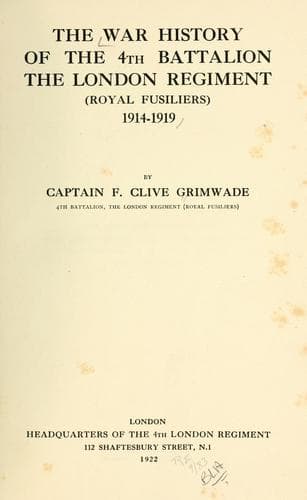
The War History of the 4th Battalion, the London Regiment (Royal Fusiliers), 1914-1919Grimwade, F. Clive
History
The War History of the 4th Battalion, the London Regiment (Royal Fusiliers), 1914-1919
Grimwade, F. Clive
Great Britain. Army. London Regiment. 4th (City of London) Battalion; World War, 1914-1918 -- Regimental histories -- Great Britain
After relief the Kensingtons in Bayencourt remained at the disposal
of the 1/4th Londons for working parties, for the construction of
the new front line was but a small beginning of the task which still
remained to be completed before the opening of the battle. In addition
to the first line there was to be dug a control trench immediately
in rear of it, and a new support line--the WS line--and all these
were to be connected up by the advancement from the old WR line of
Warrior, Welcome, Whisky, Woman and Wood Street communication trenches.
These defensive works completed, there was also the erection of the
necessary wire entanglements in front, the construction of dugouts
for shelters, company headquarters, ammunition stores, and signal
offices; the laying of armoured signal cable from all headquarters
dugouts back to battalion and brigade, the digging of cable trenches
for lines of particular importance, the collection of the necessary
supplies of small arms and trench mortar ammunition and bombs in dumps;
and other tasks of varying importance and interest. Enough has been
said, however, to indicate that with only a month in which to do all
this work it was clear that the Battalion was not likely to find time
hanging heavily on its hands while in the line,--and indeed it did not.
The tour of duty proved somewhat unpleasant. The works programme was,
of course, the outstanding duty, and all ranks put their shoulders to
it with a will, but the heavy rains which fell each day made it hard to
keep pace with the time-table set for the work, while the remarkable
aggressiveness of the enemy's guns added to the digging scheme by
providing much undesired practice in trench repair work.
During the night following the relief the Battalion's positions were
heavily bombarded by heavy guns and trench mortars, which caused much
damage and several casualties, especially in the left company front.
Capt. Elliott had to be dug out of the trench which was blown in on
him, and he was sent to hospital suffering from severe concussion;
and 3 N.C.O.'s and men were killed and 12 wounded. Capt. Elliott was
unhappily never able to return to France, and in him the Battalion lost
an officer of remarkably cool and sound judgment and of wide sympathy
with the welfare of his men.
Public-domain text, read in full here on John Shaqi.
Reviews
Reviews
No reviews yet
Be the first to share your thoughts on this work.
Elsewhere in the archive
Join the Discussion
Join the discussion
Sign in to leave a comment or review.
Sign InorCreate an account