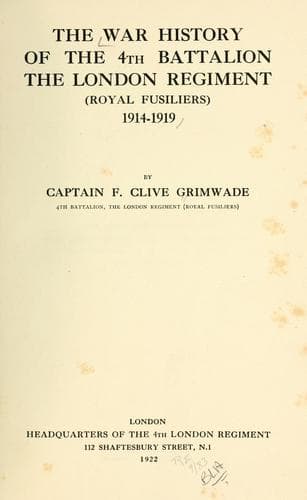
The War History of the 4th Battalion, the London Regiment (Royal Fusiliers), 1914-1919Grimwade, F. Clive
History
The War History of the 4th Battalion, the London Regiment (Royal Fusiliers), 1914-1919
Grimwade, F. Clive
Great Britain. Army. London Regiment. 4th (City of London) Battalion; World War, 1914-1918 -- Regimental histories -- Great Britain
On the night of the 25/26th May the setting out of the work was safely
accomplished by the Royal Engineers under cover of a screen of scouts,
and the following night a working party of 3000 men got to work on the
digging, a line of outposts being established for their protection
within 200 yards of the German line.
The Battalion responsible for W--the right or southern--sector of the
new line was the 1/4th Londons, the work being under the control of
Major Duncan-Teape, while the L.R.B. undertook the work in Y sector.
The night luckily passed quietly, and all ranks working with a will the
new trench, shown on map as W 47, W 48, W 49 and W 50, was opened and
sunk to a depth sufficient to provide cover.
When the Battalion, therefore, took over W sector on the night of
the 28th May, the new front line was becoming fit to occupy and had,
moreover, reached the anticipated stage in which, the Bosche being
alive to what had been done, it was becoming a favourite target for his
shells and trench mortar bombs of all calibres. From this time onwards,
in fact until the battle, the Divisional sector and in particular the
new trenches were daily harassed by the enemy's fire, and constant
repair work on the part of our trench garrisons was called for in
addition to the continuance of new construction.
The front line of W sector was taken up by A Company (A. R. Moore) on
the right with B Company (S. Elliott) on the left, supports to both
front line companies being found by D Company (Giles), while C Company
(Long) was in reserve at Hébuterne. Battalion Headquarters occupied
dugouts beneath a roller flour mill in Hébuterne. The move forward
from Bayencourt for this relief being made in daylight was carried out
across country along tracks, platoons moving separately at 300 yards
distance.
Public-domain text, read in full here on John Shaqi.
Reviews
Reviews
No reviews yet
Be the first to share your thoughts on this work.
Elsewhere in the archive
Join the Discussion
Join the discussion
Sign in to leave a comment or review.
Sign InorCreate an account