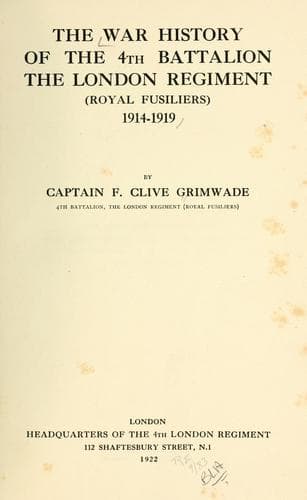
The War History of the 4th Battalion, the London Regiment (Royal Fusiliers), 1914-1919Grimwade, F. Clive
History
The War History of the 4th Battalion, the London Regiment (Royal Fusiliers), 1914-1919
Grimwade, F. Clive
Great Britain. Army. London Regiment. 4th (City of London) Battalion; World War, 1914-1918 -- Regimental histories -- Great Britain
The 5th, 6th and 7th June were spent in training, of which the
principal feature was a practice attack over trenches constructed to
represent those opposite the sector of line which the Battalion had
just left, in preparation, of course, for the coming battle. Following
the last day's practice the Battalion was inspected by the Third Army
commander, Sir Edmund Allenby, who was accompanied by Major-Gen. Hull
and Brig.-Gen. Loch, and expressed himself satisfied with all that he
had seen and also with what he had heard of the Battalion's behaviour
during its recent tour of duty. A report of this kind may read
curiously at first in view of the fact that the Battalion had been in
France for eighteen months and had proved its steadiness in the line on
many occasions: but remember that the 56th Division was brand new, and
commanders so far did not know how their troops would shape in action.
Praise from Allenby at this stage was therefore praise indeed.
The same day the Battalion was once more sent adrift from its own
Brigade and became attached for duty to the 169th Brigade, though it
retained its billets at Halloy, and the 168th Brigade took over W and Y
sectors, Headquarters moving from Grenas to Sailly.
The Battalion now became responsible for the various works duties in
the back area, relieving the L.R.B. in this monotonous task; and from
this date onwards remained hard at work on various tasks until almost
the eve of battle. B Company was despatched to Mondicourt, an important
and vast R.E. dump on the Doullens-Arras Road, for work under the
R.E.'s. The remaining companies were split up to supply parties for the
daily work, the total numbers found each day being 8 officers and 350
other ranks, employed on such varied tasks as digging road material in
Halloy quarries; carrying logs at Pas for gun emplacements; shifting
and loading timber at Mondicourt; and working in the R.E. workshop at
Pas. This programme was pushed forward without a break until the 12th
June, the only intermission being an inspection on Sunday the 11th,
of such remnants of the Battalion as were available, by Sir Charles
Wakefield, then Lord Mayor of London, who was accompanied by Major-Gen.
Hull and Col. Evelyn Wood, and addressed the troops.
On the 13th a further redistribution of Brigades took place, the 168th
remaining in line but retaining W sector only; Y sector was handed over
to the 169th Brigade; while the 167th moved back into reserve. This
move placed the Brigades in the positions they were destined to occupy
on the day of battle. The same day the 1/4th Londons moved forward,
leaving Halloy at 5 p.m., and marching _via_ Authie, St Leger and
Coigneux to Bayencourt, where it was joined in billets by B Company
from detachment at Mondicourt. A Company was pushed straight on to
Hébuterne, when in spite of its long march and late arrival in billets
it set to work on its share of the Brigade works programme at 5 a.m. on
the 14th June.
Public-domain text, read in full here on John Shaqi.
Reviews
Reviews
No reviews yet
Be the first to share your thoughts on this work.
Elsewhere in the archive
Join the Discussion
Join the discussion
Sign in to leave a comment or review.
Sign InorCreate an account