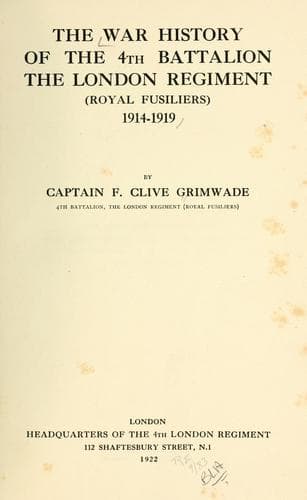
The War History of the 4th Battalion, the London Regiment (Royal Fusiliers), 1914-1919Grimwade, F. Clive
History
The War History of the 4th Battalion, the London Regiment (Royal Fusiliers), 1914-1919
Grimwade, F. Clive
Great Britain. Army. London Regiment. 4th (City of London) Battalion; World War, 1914-1918 -- Regimental histories -- Great Britain
The remaining companies were also set to work on the 14th in Hébuterne
on parts of the Brigade scheme, working hours being nightly from 9
p.m. to 5 a.m. The parties were much split up, 280 being detailed to
the 2/2nd Field Company R.E., 140 to the 5th Cheshires and 140 to the
Brigade Signal Officer for digging cable trenches. The tasks were
various, but were all directed in one way or another to the completion
and repair of the new trench system and the necessary dugouts for
the impending offensive. Night after night, for fourteen nights in
succession, did the Battalion continue these stiff working parties.
Each night there was a march of nearly three miles in each direction
between billets and work, each night the Bosche was unpleasantly active
with machine-guns, and nearly every night it rained steadily. That the
Battalion carried out this depressing duty--for there is nothing with
which the average infantryman gets more quickly "fed up" than continual
working parties--with such efficiency and keenness is all the more to
its credit. Conditions were not comfortable and the men were beginning
to be tired; but they stuck to it well for they knew the urgency of the
work and how much remained to be done in an impossibly short time.
On the 21st June the 167th Brigade took over the whole Divisional
sector for six days in order to give a final rest to the 168th and
169th and to keep them as fresh as possible for battle. The 168th
withdrew to its old rest billets at Halloy, but again the 1/4th Londons
were left behind as works battalion, remaining in Hébuterne attached to
the 167th Brigade and sticking to its works programme.
On the 23rd June Lieut. W. J. Boutall rejoined the Battalion from home
and was posted to D Company, but almost immediately took up the duties
of Assistant Adjutant.
A draft of the 2/4th Battalion arrived on the 24th, consisting of
Lieut. J. R. Webster and 40 other ranks.
Affairs in the line had now begun to "tune up." Some days previously
the British 9·2 batteries in Bayencourt had begun to register, while
on the 24th the preliminary bombardment of the enemy's lines began
systematically, with occasional intense periods, alternating with
intervals of quiet. This continued daily--and nightly--much to the
discomfort of those who were lucky enough to occupy billets with more
or less sound ceilings, for their nights were continually disturbed by
large pieces of plaster falling on them at each concussion! The attack
had been originally projected for the 29th June, and in preparation for
this the 168th and 169th Brigades returned to the line in the afternoon
of the 27th, the 1/4th Londons advancing from Bayencourt, taking over
the whole of W sector from the 8th Middlesex.
The sector was occupied on a three-company frontage as follows:
D Company--(Giles) with two platoons in W 47 and 48, one
platoon in W 47 S and one in billets in Hébuterne.
Public-domain text, read in full here on John Shaqi.
Reviews
Reviews
No reviews yet
Be the first to share your thoughts on this work.
Elsewhere in the archive
Join the Discussion
Join the discussion
Sign in to leave a comment or review.
Sign InorCreate an account