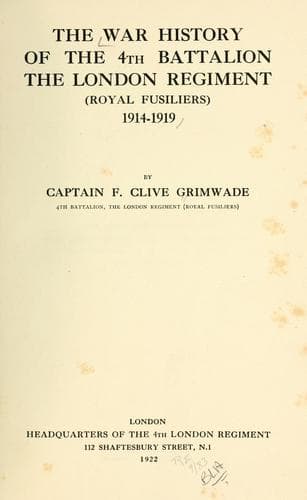
The War History of the 4th Battalion, the London Regiment (Royal Fusiliers), 1914-1919Grimwade, F. Clive
History
The War History of the 4th Battalion, the London Regiment (Royal Fusiliers), 1914-1919
Grimwade, F. Clive
Great Britain. Army. London Regiment. 4th (City of London) Battalion; World War, 1914-1918 -- Regimental histories -- Great Britain
A Company--(A. R. Moore) with two platoons in W 49, one
in W 49 S and one in billets in Hébuterne.
C Company--(Sykes) with two platoons in W 49 and 50, one
in W 50 S and one in Napier Trench.
B Company--(W. Moore) with two platoons in reserve
dugouts in Cross Street. The two remaining platoons of
B were detailed for special duties as Brigade carrying
parties respectively under the Bombing and Machine-Gun
Officers.
The Somme Battle was the first important offensive in which steps
were taken to reduce the number of officers actually taking part to
the smallest possible limits, and a "battle surplus" of officers and
also of warrant officers, N.C.O.'s and men was therefore left behind
in bivouacs near Souastre when the Battalion moved into the line.
This precaution, which was always afterwards adopted, was the means
of avoiding unnecessary casualties and of providing an immediate
reinforcement, as might be required, of fresh officers who would be
acquainted with the men. The officers left in "battle surplus" were
Capts. H. G. Stanham and A. L. Long, Lieuts. J. R. Webster and H. W.
Vernon, and 2/Lieuts. C. S. G. Blows and N. W. Williams; and these were
joined on the eve of battle by Major H. J. Duncan-Teape and Lieut. W
J. Boutall, both of whom remained in the line until the last possible
minute. Lieut. W. R. Botterill also left the line before the battle to
proceed to Woolwich R.M. College.
During the day of relief the British bombardment of the German lines
was still proceeding, occasional intensive bursts being used. At
about 7.45 p.m. on the cessation of a burst the enemy put down a very
heavy retaliatory barrage on the W and WR lines, causing a good deal
of damage, especially to the latter. In the course of this shelling
D Company's headquarters were blown in and Capt. Giles was seriously
wounded, one of his company staff killed and another wounded. Poor
Giles, who had done magnificent work as platoon commander, adjutant and
company commander, and had never missed a day's duty since August 1914,
died in hospital from his injuries a few days later. He was a gallant
and unselfish officer. His place in command of D Company was taken by
Stanham, who came forward from surplus.
Public-domain text, read in full here on John Shaqi.
Reviews
Reviews
No reviews yet
Be the first to share your thoughts on this work.
Elsewhere in the archive
Join the Discussion
Join the discussion
Sign in to leave a comment or review.
Sign InorCreate an account