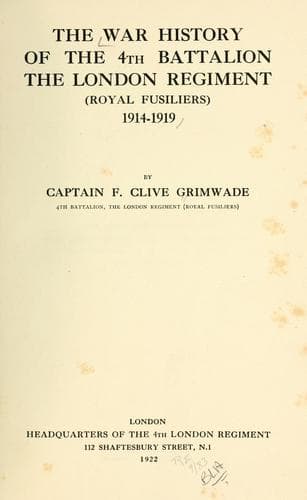
The War History of the 4th Battalion, the London Regiment (Royal Fusiliers), 1914-1919Grimwade, F. Clive
History
The War History of the 4th Battalion, the London Regiment (Royal Fusiliers), 1914-1919
Grimwade, F. Clive
Great Britain. Army. London Regiment. 4th (City of London) Battalion; World War, 1914-1918 -- Regimental histories -- Great Britain
Throughout the 29th our preliminary bombardment continued with
gradually increasing intensity; but it was noticeable that in spite of
the damage it was clearly doing to the enemy's defences it was not by
any means successful in silencing his batteries. The German artillery
was in fact unpleasantly lively, and from 6.30 a.m. until about 4.30
p.m. W sector was subjected to intermittent harassing fire from field
and machine-guns. This more or less desultory fire was followed at 6
p.m. by a sharp enemy barrage. All the evening the enemy's activity
continued, and the remarkable number of Véry lights which he put up
indicated his growing nervousness. There was indeed now every reason to
believe that the Bosche expected our attack. The long-continued British
bombardment of trenches, dumps, cross roads and battery positions, the
systematic wire-cutting, and the activity of our air forces, could have
left no room for doubt in the enemy's mind that an important offensive
was being launched. In some parts of the battle front, indeed, the
Germans had displayed notice boards inviting the British to start their
attack; and though probably these emanated from individual bravado they
formed some indication that surprise effect was not to be expected, and
that there was good reason to believe that the Germans would with their
usual thoroughness have made preparations to offer the most stubborn
possible resistance to our projected advance.
The 29th also demanded its toll of casualties from the Battalion, and
this day 28 N.C.O.'s and men were wounded.
The 30th June opened with a heavy barrage on W sector and Hébuterne
at about midnight, but this subsided after a few minutes and little
further activity was displayed by the enemy during the early morning
hours. As dawn approached the enemy's nervousness evidently increased,
and he maintained an almost continuous discharge of Véry lights.
From 7 a.m. onwards, however, the enemy artillery once more began to
show signs of liveliness which increased as the day passed. The WR
line in the vicinity of Woman and Cross Streets was in particular
heavily shelled, and altogether a great amount of damage was done
to our trench system. This action of the enemy did not call for any
particular retaliatory measures from our artillery, which proceeded
with the preliminary bombardment according to its programme. The losses
sustained by the Battalion on this day amounted to 2 N.C.O.'s and men
killed and 21 wounded, making a total of 69 casualties during the three
days the Battalion had held the line.
Public-domain text, read in full here on John Shaqi.
Reviews
Reviews
No reviews yet
Be the first to share your thoughts on this work.
Elsewhere in the archive
Join the Discussion
Join the discussion
Sign in to leave a comment or review.
Sign InorCreate an account