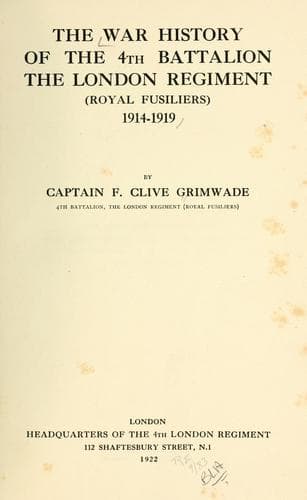
The War History of the 4th Battalion, the London Regiment (Royal Fusiliers), 1914-1919Grimwade, F. Clive
History
The War History of the 4th Battalion, the London Regiment (Royal Fusiliers), 1914-1919
Grimwade, F. Clive
Great Britain. Army. London Regiment. 4th (City of London) Battalion; World War, 1914-1918 -- Regimental histories -- Great Britain
Little has been said of the actual occupation of the Battalion during
these three days; there is so much to relate of the battle day itself
that space does not permit us to dwell overmuch on the preceding
period. But be it understood that all the time the works programme was
being pushed on with feverish haste, though progress was slow owing
to the continued rain and the great delay caused in the projected new
work by having to divert from it a large proportion of the available
strength to repair the damage caused by the daily German bombardments.
During the evening the Battalion formed up in its prearranged assembly
areas in readiness for the attack on the following morning.
* * * * *
The part which the 56th Division was called on to play in the offensive
was that of a combined operation on a comparatively small front in
conjunction with the 46th Division, which was in line opposite the
northern flank of the Gommecourt Salient and adjoining the 56th. These
Divisions which, with the 37th (not engaged), formed the VII Corps
and were the right flank of Allenby's Third Army, were the two most
northern divisions operating in the Somme offensive.
Adjoining the 56th on the right lay Hunter-Weston's VIII Corps,
comprising from left to right the 31st, 4th and 29th Divisions in line,
with the 48th in support. One Brigade of this last-named Division--the
143rd--was in line between the 56th and the 31st, and its sector formed
a gap on which no forward move was attempted. The Gommecourt operation
was therefore entirely isolated, though forming an inherent part of the
one great offensive plan.
South of the VIII Corps the British battle front was taken up by the X
Corps (Morland), III Corps (Pulteney), XV Corps (Horne) and XIII Corps
(Congreve), these forming with the VIII, Rawlinson's Fourth Army.
The 56th Division's objectives, which will be easily followed from the
map, were to capture and consolidate a line running almost due north
from a strong point at the south end of Farm-Farmyard, through Fame,
Felon, Fell, Fellow, and the Quadrilateral to the junction of Fillet
and Indus. From this point the line was to be continued to the "little
Z" (a point about 2000 yards north of the apex of the Gommecourt
Salient) by the 46th Division, who were to clear Gommecourt village and
park.
The 168th Brigade on the right of the Divisional sector attacked on a
two-battalion front from the strong point on the right to the junction
of Felon and Epte on the left. Strong points were to be consolidated
on the extreme right and also at the junctions of Felon with Elbe and
Epte. From this point the 169th Brigade was to continue the line to
the junction of Fir and Firm and also to the point of union with the
46th Division.
The 167th Brigade was in Divisional reserve, and one battalion, the 1st
Londons, was detailed to supply 600 men to dig communication trenches
across No Man's Land after the attack.
Public-domain text, read in full here on John Shaqi.
Reviews
Reviews
No reviews yet
Be the first to share your thoughts on this work.
Elsewhere in the archive
Join the Discussion
Join the discussion
Sign in to leave a comment or review.
Sign InorCreate an account