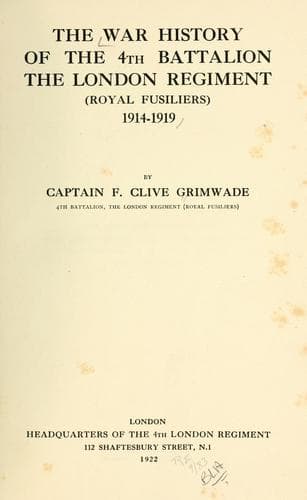
The War History of the 4th Battalion, the London Regiment (Royal Fusiliers), 1914-1919Grimwade, F. Clive
History
The War History of the 4th Battalion, the London Regiment (Royal Fusiliers), 1914-1919
Grimwade, F. Clive
Great Britain. Army. London Regiment. 4th (City of London) Battalion; World War, 1914-1918 -- Regimental histories -- Great Britain
By this time the situation on the other side of No Man's Land was
becoming desperate. The work of consolidation was almost impossible
owing to the German barrage, and the sustained bomb fighting was
rapidly becoming an unequal struggle owing to the impossibility of
replenishing the dwindling supplies of bombs. Again and again with
unsurpassed devotion the carrying party endeavoured to pass through
the barrier of German shells with the coveted supplies of bombs to our
harassed troops--but passage was impossible and the gallant carriers
only added to the roll of casualties.
At 1.30 p.m. a patrol returned from the German lines to Battalion
Headquarters. This had been despatched at 11 o'clock on a demand
from the Brigadier for information as to the left of the Brigade in
the German line, and Ptes. Whitehead and Buckingham had volunteered
for the duty. According to this patrol a party of the Rangers under
Lieut. Harper were holding on to the junction of Et and Felt, but was
urgently in need of bombs. Further, none of the 168th Brigade were then
in the German third line. This report was passed on to Brigade and to
the Rangers, and a special bomb carrying party from the Battalion was
ordered across to relieve Harper's need. But none reached the German
line, all being killed or wounded in No Man's Land. For their bravery
and devotion to duty Ptes. Whitehead and Buckingham were rewarded
with the Military Medal, and the former was subsequently granted a
commission.
At 2.30 p.m. the front of the Battalion Headquarters dugout was blown
in by a shell, which killed seven and wounded seven men. At the time
the dugout was occupied by a large number of Headquarters staff,
including the Colonel, the Adjutant, the Signalling Officer and Major
Moore, but of these luckily none was hit.
All this time the German shell fire continued without abatement, and at
3.30 p.m. further heavy casualties were reported by D Company. At 3.45
p.m. Brigade Headquarters ordered D Company to withdraw to the WR line,
and a report was received from Stanham at 4.45 p.m. that his withdrawal
with 1 officer and 20 men was complete.
Meanwhile the Brigade was gradually being compelled to give ground and,
owing to its lack of bombs, to loose its slender hold on the enemy's
positions. At about 2 p.m. the remnants of the Rangers, together with
a few 1/4th Londons and some Queen Victorias from the 169th Brigade
on the left, were driven into Fate, where they made a last determined
stand; but at 3.10 p.m. they were finally ejected from the German lines
and withdrew to the British trenches.
Public-domain text, read in full here on John Shaqi.
Reviews
Reviews
No reviews yet
Be the first to share your thoughts on this work.
Elsewhere in the archive
Join the Discussion
Join the discussion
Sign in to leave a comment or review.
Sign InorCreate an account