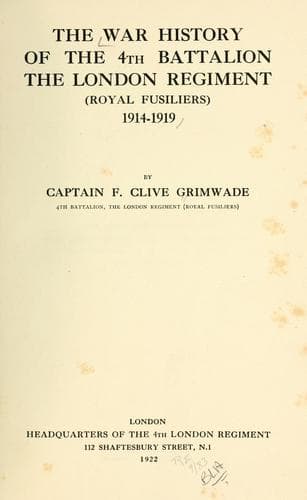
The War History of the 4th Battalion, the London Regiment (Royal Fusiliers), 1914-1919Grimwade, F. Clive
History
The War History of the 4th Battalion, the London Regiment (Royal Fusiliers), 1914-1919
Grimwade, F. Clive
Great Britain. Army. London Regiment. 4th (City of London) Battalion; World War, 1914-1918 -- Regimental histories -- Great Britain
On the right the Scottish and Kensingtons met with a similar fate. A
gallant fight was put up by the remains of the Battalion under Capt. H.
C. Sparks in Farm-Farmyard, but by 4 p.m., both his flanks being in the
air and his whole force being in imminent danger of extinction, Sparks
decided to withdraw, this operation being stubbornly and successfully
carried out after the removal of as many wounded as possible.
At 6.30 p.m. the 1/4th Londons reformed in the WR line between Wood
Street and Woman Street, and later in the evening moved into the
trenches west of Hébuterne.
The other battalions of the 168th were also withdrawn and the sector
was taken over by the 167th Brigade.
The story of the 169th Brigade attack is, like that of the 168th, one
of initial success which could not be maintained. The line Fell-Feud
was carried in the early hours of the morning by the Queen Victorias
and London Rifle Brigade, but the intensity of the German shell fire
and the enfilading of the captured positions by machine-guns in
Gommecourt Park prevented the Queen's Westminsters from carrying the
Quadrilateral. Later in the day lack of bombs, as in the case of the
168th Brigade, proved the deciding factor, and resulted in a gradual
loss of the Brigade's grip on the enemy trenches, and after desperate
struggles the late afternoon hours found them also beaten back to their
original lines.
So ended the first day on which the 56th Division had been in battle, a
day on which after the most stubborn fighting and unsurpassed devotion
the gain of ground was nil, and which dealt London the severest blow in
loss of personnel that it ever suffered on any single day throughout
the War.
The losses in the Division during the period 24th June to 3rd July
amounted to 4749 all ranks, of whom 35 officers and 412 other ranks
were killed, 107 officers and 2632 other ranks wounded, and 40 officers
and 1532 other ranks missing. In the 1/4th Londons the losses for
the same period totalled the appalling number of 16 officers and 534
other ranks. These dreadful losses were borne fairly equally by all
companies, for all had been exposed to the same deadly and unrelenting
shell fire throughout the day.
Of A Company, gallantly led to the second German line by Capt. A. R.
Moore, M.C., but 18 returned. Moore himself and one of his subalterns,
F. C. Fanhangel, were killed, the other subaltern, A. G. Blunn, being
captured with 7 others. The rest of the company were killed. Moore's
end, like his life, was one of courageous devotion, and has been simply
told by one of his own sergeants: "Capt. Moore was wounded in the
wrist about thirty minutes before we went over. Nevertheless he led
the company, revolver in hand, and on the sunken road at the rear of
Nameless Farm I saw blood flowing from his back. He still pushed on,
and then I was shot through the leg and took shelter in a shell hole.
The last I saw of Capt. Moore he was still going ahead...."
Public-domain text, read in full here on John Shaqi.
Reviews
Reviews
No reviews yet
Be the first to share your thoughts on this work.
Elsewhere in the archive
Join the Discussion
Join the discussion
Sign in to leave a comment or review.
Sign InorCreate an account