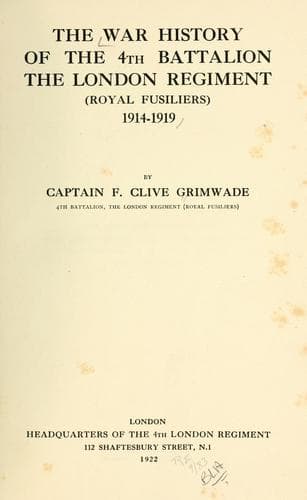
The War History of the 4th Battalion, the London Regiment (Royal Fusiliers), 1914-1919Grimwade, F. Clive
History
The War History of the 4th Battalion, the London Regiment (Royal Fusiliers), 1914-1919
Grimwade, F. Clive
Great Britain. Army. London Regiment. 4th (City of London) Battalion; World War, 1914-1918 -- Regimental histories -- Great Britain
We have sufficiently elaborated the causes of failure. It must not
be forgotten that a very real and important result was achieved by
the Londoners this day. The strategic object of their attack was not
primarily the capture of ground but the holding of German troops and
guns from the area of our main attack. This was an unpleasant rôle,
but a highly important one, and there can be no manner of doubt that
it was to a very large degree fulfilled. The Division's achievement
is summarised concisely in the message of congratulation issued by
Lieut.-Gen. D'Oyly Snow on the 4th July:
The Corps Commander wishes to congratulate all ranks of the 56th
Division on the way in which they took the German trenches and
held them by pure grit and pluck for so long in very adverse
circumstances. Although Gommecourt has not fallen into our hands,
the purpose of the attack, which was mainly to contain and kill
Germans, was accomplished, thanks to a great extent to the tenacity
of the 56th Division.
A remarkable incident occurred on the Divisional front on the 2nd
July. At about 2.30 p.m. that day a number of German stretcher-bearers
were seen to issue from their trenches and begin collecting the many
British wounded who were still lying round about their first three
lines of trenches. Prompt measures of precaution were taken by the
Division, and all guns were made ready to open fire on barrage lines
should any intention be shown by the Germans to take advantage of the
temporary truce. As, however, the enemy stretcher-bearers continued
their humane work quietly, our own stretcher-bearers followed their
example and began collecting casualties from No Man's Land. During this
extraordinary armistice no attempt was made by the Germans to come
outside or by our men to go beyond the line which had formerly been the
German wire entanglements. After about two hours of this work, which
was the means of saving many lives, the stretcher-bearers returned by
mutual and tacit consent to their own lines and the War was resumed!
* * * * *
The casualties suffered by the 46th Division were exceedingly heavy,
and the treatment it had received was so severe that it was deemed
necessary to withdraw it from the line temporarily, and arrangements
were made for the 56th Division to assume responsibility at once for
the 46th sector as well as its own.
This arrangement unfortunately deprived the 168th Brigade of its
well-earned rest. But though tired and in need of reorganisation after
the heavy losses it had sustained the Brigade's morale was good, for it
felt justifiably proud of its effort of the previous day. The relief
of the 46th Division began on the evening of the 2nd July when the
Scottish and the Kensingtons took over the line from the left of the
56th sector of the Fonquevillers-Gommecourt Road.
Public-domain text, read in full here on John Shaqi.
Reviews
Reviews
No reviews yet
Be the first to share your thoughts on this work.
Elsewhere in the archive
Join the Discussion
Join the discussion
Sign in to leave a comment or review.
Sign InorCreate an account