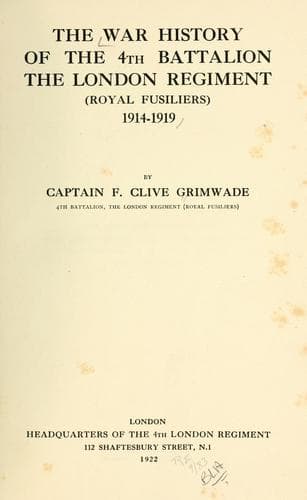
The War History of the 4th Battalion, the London Regiment (Royal Fusiliers), 1914-1919Grimwade, F. Clive
History
The War History of the 4th Battalion, the London Regiment (Royal Fusiliers), 1914-1919
Grimwade, F. Clive
Great Britain. Army. London Regiment. 4th (City of London) Battalion; World War, 1914-1918 -- Regimental histories -- Great Britain
The third and most important cause lay in the cunning skill with which
the German barrage was used. We have referred above to the manning of
the German parapets by their garrisons after our barrage had passed
over; but not in every case did this happen. In many instances a
greater refinement of skill was exhibited. As the British barrage
lifted off the first objective and the leading waves of the assault
poured over it, down came the enemy barrage like a dense curtain,
cutting them off for ever from their supports and their supplies. The
barrage having thus trapped them, the front trench filled with Germans
swarming up from their subterranean shelters, and these poured a hail
of machine-gun fire into the backs of our waves which were pushing
forward to the next line.
After the experience of two more years of organised trench to trench
attacks, it may be that failure for the reasons detailed above seems
a little obvious; but it would not be fair to pass them over without
pointing out that this was the first trench to trench attack of the
whole War which had been organised on so vast a scale, and it was
clearly impossible to provide against all eventualities when there
was no previous experience to act as a guide. It should be remembered
that in the south, where a greater degree of surprise was attained,
the arrangements for attack--which were substantially the same as in
the north--worked splendidly and resulted in marked success. And in
subsequent attacks attention was paid to the experience gained on this
great opening day of the First Somme Battle in increasing the strength
of counter-battery artillery and in making more efficient arrangements
for "mopping-up" captured lines.
As regards the 168th Brigade attack, in addition to the above general
criticisms, it may be remarked that the event showed that on the left
of the Brigade at least there was insufficient weight in the attack.
The Scottish on the right had to advance 250 yards and were able to
carry their objectives; but on the left the depth to be penetrated
was about 450 yards, and this proved too great for the available
strength of the Rangers, who were organised in five waves, even when
strengthened by two additional waves supplied by the companies of the
1/4th Londons.
A deal of congestion in the trenches and a great many casualties were
caused by the lack of those deep dugouts with which the Germans were
so well supplied, and in the case of the 1/4th Londons at any rate it
seems likely that they might have been of more use when called upon had
they been able to obtain efficient shelter during the hours of waiting.
Public-domain text, read in full here on John Shaqi.
Reviews
Reviews
No reviews yet
Be the first to share your thoughts on this work.
Elsewhere in the archive
Join the Discussion
Join the discussion
Sign in to leave a comment or review.
Sign InorCreate an account