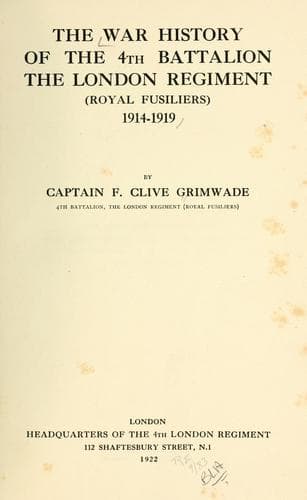
The War History of the 4th Battalion, the London Regiment (Royal Fusiliers), 1914-1919Grimwade, F. Clive
History
The War History of the 4th Battalion, the London Regiment (Royal Fusiliers), 1914-1919
Grimwade, F. Clive
Great Britain. Army. London Regiment. 4th (City of London) Battalion; World War, 1914-1918 -- Regimental histories -- Great Britain
At this point the Battalion may be said finally to have finished its
share in the battle of the 1st July. Although not detailed as one of
the assaulting battalions in the attack, the strain to which it was
subjected both in actual hard work prior to the battle and by reason
of the enemy fire during the action, was as heavy as that borne by
any unit of the Division, while its casualties were among the most
severe. Starting at Bayencourt on the 13th June the Battalion had
supplied heavy working parties with long hours of work and with a
three-mile march in each direction to and from work for fourteen nights
in succession, always harassed by the enemy fire and frequently wet
through. For three nights of unusual enemy activity they had held the
line prior to the battle, and this duty was followed without respite
by the day of battle itself. After a brief interlude of two days in
billets it had once more returned to the trenches on the additional and
unexpected duty at Fonquevillers, and had there passed a further four
days in extreme discomfort--a record of which we think any battalion
might justly be proud.
The extended front now held by the Division rendered a prolonged rest
for the Brigade out of the question, and the Battalion's sojourn at
St Amand was of only three days' duration. Of these days the first
two were occupied in refitting the troops as far as possible, and in
cleaning up and drying clothing after the days spent in the line. The
last day, Sunday 9th July, was occupied with Church Parade and, in
the afternoon, a Brigade Parade at Souastre for inspections by the
Corps and Army Commanders, both of whom addressed the Brigade in
congratulatory terms.
On the afternoon of the 10th the 168th Brigade returned to the trenches
at Hébuterne, there relieving the 167th. An adjustment of sectors
was now effected as a result of which the 168th Brigade held the
right sector of the Divisional front, comprising the old W sector and
the part of Y sector south of the Hébuterne-Gommecourt Road; in the
centre was the 167th Brigade between the Hébuterne-Gommecourt and the
Fonquevillers-Gommecourt Roads; while the 169th Brigade held the left
of the Divisional front.
The 168th front was occupied by the London Scottish in the right
subsector and the Kensingtons on the left. The 1/4th Londons took over
billets at Bayencourt, while the Rangers moved to Sailly.
On the 17th the Battalion relieved the London Scottish in the right
subsector of the Brigade front, the relief being complete by 6 p.m. The
same day the Rangers took over the left subsector from the Kensingtons.
Public-domain text, read in full here on John Shaqi.
Reviews
Reviews
No reviews yet
Be the first to share your thoughts on this work.
Elsewhere in the archive
Join the Discussion
Join the discussion
Sign in to leave a comment or review.
Sign InorCreate an account