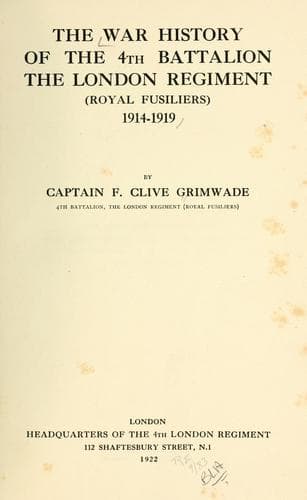
The War History of the 4th Battalion, the London Regiment (Royal Fusiliers), 1914-1919Grimwade, F. Clive
History
The War History of the 4th Battalion, the London Regiment (Royal Fusiliers), 1914-1919
Grimwade, F. Clive
Great Britain. Army. London Regiment. 4th (City of London) Battalion; World War, 1914-1918 -- Regimental histories -- Great Britain
The principal operation carried out by the Battalion during this tour
of duty was the filling in of the advanced front line. This had been so
seriously damaged during the battle as to become almost untenable, and
the labour which would be involved in its repair and maintenance did
not appear to be justifiable. Accordingly the task of filling it and
the communication trenches as far back as the WS line was carried out
on the night 18/19th July. The portion from Whisky Street southwards
was dealt with by 2 officers and 140 men of C Company, while the part
north of Whisky Street was filled in by 120 men of the Kensingtons. A
covering party in No Man's Land of 2 platoons' strength secured the
safety of the working party.
This step clearly indicated that all ideas of an advance on this front
were--for the moment at any rate--given up, but the rôle played by
the Division during the remainder of its duty at Hébuterne was such
as to foster an offensive spirit in the troops by means of constant
patrolling activity and a general policy of aggression against the
enemy's defences and working parties. This rôle was the more important
on account of the striking developments which were occurring in the
British offensive operations nearer the Somme, where the pressure which
was being brought to bear on the Germans was severe and continually
increasing. Gradually the enemy was being compelled to push his
reserves into the fight and limit as far as possible his activities on
other parts of the front. Any action at Hébuterne, therefore, which
could prevent the withdrawal of the opposing garrison to the battle
area further south had a direct and important bearing on the fortunes
of the British arms.
On the nights of the 20th, 21st and 22nd July strong patrols were sent
out from the Battalion under 2/Lieuts. W. E. Osborne, H. W. Vernon and
J. C. Graddon respectively, with the object of securing a live prisoner
captured from a German patrol. No success, however, was achieved.
On the 23rd July an inter-battalion relief again took place and the
Battalion was relieved by the London Scottish withdrawing on relief to
Brigade support billets at Sailly, but leaving B Company in the Keep in
Hébuterne to furnish working parties.
The Battalion remained in Sailly supplying working parties in the
forward area until the end of July. Advantage was taken of this
period out of the line to straighten out some "cross-postings" which
had occurred among drafts of N.C.O.'s and men recently sent up from
the Base, and drafts of Queen's Westminsters and 3rd London men were
despatched from the Battalion to rejoin their own units. At the same
time the Battalion received drafts of 4th London men from the Queen
Victorias and the Kensingtons, to whom they had been sent in error.
Public-domain text, read in full here on John Shaqi.
Reviews
Reviews
No reviews yet
Be the first to share your thoughts on this work.
Elsewhere in the archive
Join the Discussion
Join the discussion
Sign in to leave a comment or review.
Sign InorCreate an account