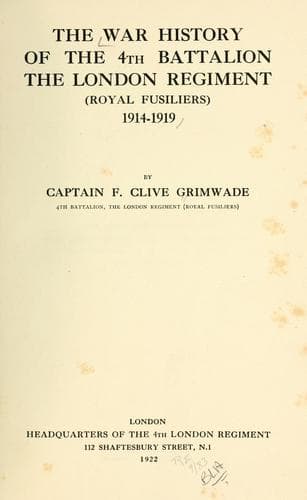
The War History of the 4th Battalion, the London Regiment (Royal Fusiliers), 1914-1919 — John Shaqi
The War History of the 4th Battalion, the London Regiment (Royal Fusiliers), 1914-1919Grimwade, F. Clive
History
The War History of the 4th Battalion, the London Regiment (Royal Fusiliers), 1914-1919
Grimwade, F. Clive
Great Britain. Army. London Regiment. 4th (City of London) Battalion; World War, 1914-1918 -- Regimental histories -- Great Britain
The available accommodation proving utterly inadequate for the growing
numbers, the 2/4th Battalion moved on 23rd September, after inspection
by the Lord Mayor, Sir Vansittart Bowater, to quarters under canvas at
Folly Farm, New Barnet. The strength was now 6 officers and 480 other
ranks, and steadily increased from this time until the establishment
in all ranks was filled. Training now began in earnest--so far as the
wills of every officer, N.C.O., and man were concerned--but under the
most acute practical difficulties, such as were general among the newly
raised formations, owing to the lack of stores of all kinds, including
clothing, arms, and equipment. Gradually, however, "wooden equivalents"
gave place to rifles, and mufti made its final disappearance from the
parade ground. During the following month the Battalion moved into
winter quarters, occupying as barracks two vacant houses at Barnet,
namely, "Littlegrove" and "Beech Hill," and also some stabling and
out-buildings at "Oakhill."
The Battalion owes a considerable debt of gratitude to the owners of
these houses and to other local residents, notably to W. H. Vernon,
Esq., and Sir Philip Sassoon, for their generosity in providing
accommodation and training facilities and for extending hospitality to
the Battalion in various ways, generosity which was also extended to
the 4/4th (Reserve) Battalion when it was formed in the following year.
Facilities for musketry training were also provided by the Enfield
Rifle Club, who very generously placed their range and the services
as instructors of several of their members at the disposal of the
Battalion.
Training at Barnet continued until 14th December 1914, when, after
inspection by Lieut.-Gen. G. H. Moncrieff, Honorary Colonel of
the Regiment, the Battalion, which had now grown to a strength of
27 officers and 986 other ranks, joined the Brigade in billets at
Maidstone. Here the Brigade received on the 17th a warning order to
proceed on foreign service at short notice. The necessary preparation
of equipment, medical inspection, inoculation, etc., was at once put in
hand, and the Battalion was inspected by Major-General W. Fry, C.B.,
C.V.O., commanding 1st London Division, who addressed the troops.
It was fortunately possible to grant forty-eight hours' leave to all
ranks before departure, destined to be the last home leave for some
nineteen months, and on 23rd December the Battalion entrained at 10
a.m. for Southampton, where it embarked on H.T. _Avon_ (Royal Mail
Steam Packet Company), the strength on embarkation being 27 officers
and 889 other ranks.
The following officers proceeded overseas with the Battalion:
Public-domain text, read in full here on John Shaqi.
Reviews
Reviews
No reviews yet
Be the first to share your thoughts on this work.
Join the Discussion
Join the discussion
Sign in to leave a comment or review.
Sign InorCreate an account