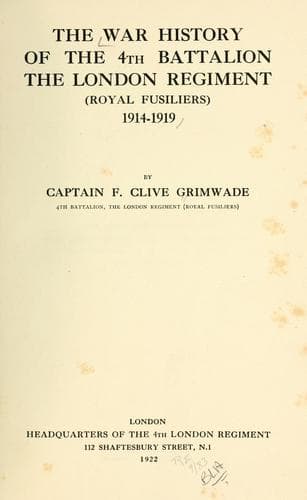
The War History of the 4th Battalion, the London Regiment (Royal Fusiliers), 1914-1919Grimwade, F. Clive
History
The War History of the 4th Battalion, the London Regiment (Royal Fusiliers), 1914-1919
Grimwade, F. Clive
Great Britain. Army. London Regiment. 4th (City of London) Battalion; World War, 1914-1918 -- Regimental histories -- Great Britain
On the 14th July the British attacked the second system on a front from
Bazentin-le-Petit to Longueval. This attack, which was successful,
was pressed forward to High Wood, of which practically the whole
was captured, and thus secured for us a footing on the Main Ridge,
dividing the German forces on the west and centre portions of it. The
advance was consolidated and rounded off locally in the direction
of Guillemont; but the new positions formed an abrupt and narrow
salient in our line, and before a further advance to the German third
system could be contemplated it was necessary for the British hold on
the Main Ridge to be widened. It was considered by G.H.Q. that the
Pozières-Thiepval series of fortresses at the western extremity of the
ridge was too powerful to yield to frontal attack, and it was therefore
decided to extend the hold on the centre portion of the ridge. This
postulated the capture of Guillemont, Ginchy and Combles, and a
swinging-up of the British right flank which rested on the Combles
valley. The French were to co-operate on the right of the Combles
valley by the capture of Frégicourt and Rancourt. Combles itself,
immensely fortified and strongly garrisoned, was too formidable an
obstacle to be likely to fall into our hands by direct attack, except
at an appalling cost of life; and it was therefore to be enveloped, the
British advancing on the heights west of it and the French to its east.
It is with this great outflanking movement for the capture of Combles
and the securing of the Main Ridge immediately west of it that the 56th
Division and the l/4th Londons are concerned.
Guillemont was first attacked on the 23rd July, but it was not until
after repeated attempts that it finally fell into our hands on the 3rd
September. On that day the line was advanced to the outskirts of Ginchy
and to the Wedge Wood-Ginchy Road, Falfemont Farm falling to us on the
5th.
Meanwhile local improvements had been made in our positions in various
parts of the line, and the bitter fighting of August, though productive
of no very deep advance was of the greatest value. It not only widened
our hold on the ridge, but also by a series of unrelenting sledgehammer
blows had a cumulative effect on the German morale and thus paved the
way for the greater successes of September.
* * * * *
The 168th Brigade continued training in the St Riquier area until
the end of August, the 1/4th Londons retaining their billets at Le
Plessiel. The training was rendered peculiarly interesting by reason of
the first appearance of the "Heavy Section Machine-Gun Corps," better
known as Tanks. These engines of war, which were regarded at first by
the troops with a good deal of wonderment and not a little misgiving,
only arrived in France on the 25th August. No time was lost in testing
them and giving infantry troops an opportunity to co-operate with them
in practice prior to their employment in action.
Public-domain text, read in full here on John Shaqi.
Reviews
Reviews
No reviews yet
Be the first to share your thoughts on this work.
Elsewhere in the archive
Join the Discussion
Join the discussion
Sign in to leave a comment or review.
Sign InorCreate an account