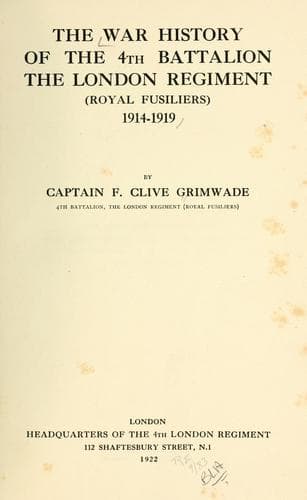
The War History of the 4th Battalion, the London Regiment (Royal Fusiliers), 1914-1919Grimwade, F. Clive
History
The War History of the 4th Battalion, the London Regiment (Royal Fusiliers), 1914-1919
Grimwade, F. Clive
Great Britain. Army. London Regiment. 4th (City of London) Battalion; World War, 1914-1918 -- Regimental histories -- Great Britain
The 56th Division received the compliment of being one of the units
selected by G.H.Q. to co-operate with Tanks on the occasion of their
first appearance in battle, and accordingly a series of practice
schemes was begun on the 26th August, the Brigades of the 56th Division
being employed in turn. Needless to say the interest aroused by the
strange appearance of these iron monsters was intense and speculation
was rife as to their potential value in action, not only among the
troops, but also among the many staff officers who were present at
the demonstrations. Unfortunately the time allowed for "tuning up"
the engines was inadequate, the result being that during the first
practices the Tanks showed a most undesirable predilection for breaking
down--a habit not calculated to inspire with confidence the infantry
who were expected to follow them. However, these difficulties were
largely overcome, and by the 2nd September, when the 168th Brigade's
turn for practising with them arrived, the Tanks were working well.
In spite of the misgivings as to the tactical value of the Tanks which
presented themselves to the minds of those inclined to pessimism,
their arrival undoubtedly gave enormous encouragement to the troops
who were enabled at last to realise that the enemy were not always to
be first in the field with new inventions; and the anticipation of a
great surprise effect when the Tanks should first appear before the
enemy trenches brought all ranks to the tip-toe of expectation. The
strict injunction which was issued to avoid mention of the Tanks in
correspondence was most loyally obeyed.
On the 2nd September a warning order was received that the Division
would move forward to the battle area, and the following day the 168th
and 169th Brigades moved to the Corbie area. The Battalion left Le
Plessiel in the afternoon of the 3rd, marching to St Riquier, where
it entrained for Corbie, a town of some size at the confluence of
the Ancre and the Somme. Here the Battalion detrained at 11.15 p.m.,
marching, with the Rangers, to billets at Vaux-sur-Somme. The remainder
of the Brigade was accommodated a mile further forward at Sailly-le-Sec.
The Division now came under the orders of the XIV Corps (Cavan), the
extreme right of the British Army, consisting of the 5th, 16th and 20th
Divisions, which had this day been operating on the Guillemont front in
the action already alluded to.
Public-domain text, read in full here on John Shaqi.
Reviews
Reviews
No reviews yet
Be the first to share your thoughts on this work.
Elsewhere in the archive
Join the Discussion
Join the discussion
Sign in to leave a comment or review.
Sign InorCreate an account