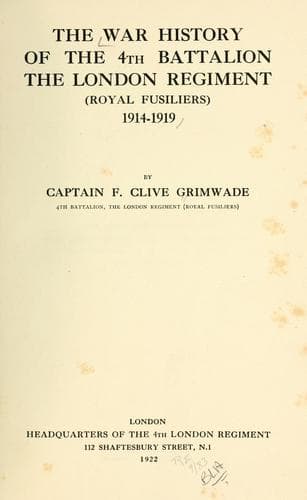
The War History of the 4th Battalion, the London Regiment (Royal Fusiliers), 1914-1919Grimwade, F. Clive
History
The War History of the 4th Battalion, the London Regiment (Royal Fusiliers), 1914-1919
Grimwade, F. Clive
Great Britain. Army. London Regiment. 4th (City of London) Battalion; World War, 1914-1918 -- Regimental histories -- Great Britain
On the morning of the 4th orders were received, without any previous
intimation that they might be coming, for the Battalion to move
forward at once. The whole Battalion, less personnel of the transport
and vehicles, marched out of Vaux-sur-Somme within one hour of the
receipt of these orders--a credit to the high state of organisation
to which the Battalion had been trained since leaving the Hébuterne
area. Boutall writes: "The march was a long and tedious one and I think
I am right in asserting that not a single man fell out on the way. I
distinctly remember Lieut.-Col. Wheatley congratulating himself on the
fact."
This march terminated at a large concentration camp known as the
Citadel about two miles north of Bray. At the Citadel the Battalion
was able to form a vague idea for the first time of the enormous
effort being put forth by the British in this already long drawn-out
struggle. The concentration camp covered an enormous area on the
rolling hillsides above the Somme and presented an astounding spectacle
of numbers of units from every arm of the Service--gunners, infantry,
engineers--besides vast stores of materials of all kinds. The roar
of the guns in the inferno of the battle line seemed to speak to the
troops of the great and yet increasing power of the British Armies,
and filled every heart with hope and confidence. To many of those who
remembered the lean days of 1915 when the British battle line was
starved for men and shells, this first contact with the reality of the
Empire's strength was almost overpowering.
On the 5th September the Division took the place in Corps Reserve of
the 20th Division, which had been withdrawn from the fighting line, and
in the evening of the same day the relief of the 5th Division in the
line began.
The front taken over from the 5th Division was the extreme right of the
line from its junction with the French, overlooking the Combles valley
to the left of Leuze Wood. The 169th Brigade (relieving the 15th)
took over the right sector and the 168th Brigade (relieving the 95th)
assumed responsibility in the left sector.
September had set in with steady rain which had already converted
all the roads, tracks and camping grounds into seas of liquid mud.
The Battalion, which since arrival at the Citadel had been held at
short notice to move, advanced during the afternoon of the 5th, in
full battle kit in the direction of the line. The state of the ground
made marching an impossibility, and after sliding along for some time
uncomfortably in the mud, orders were received for the Battalion to
return to the Citadel. The change of plan was, as usual, received with
philosophical resignation, and the men turned in to take advantage of
the short respite only to be roused again a few hours later the same
evening when the advance to the line began at 11.15 p.m.
Public-domain text, read in full here on John Shaqi.
Reviews
Reviews
No reviews yet
Be the first to share your thoughts on this work.
Elsewhere in the archive
Join the Discussion
Join the discussion
Sign in to leave a comment or review.
Sign InorCreate an account