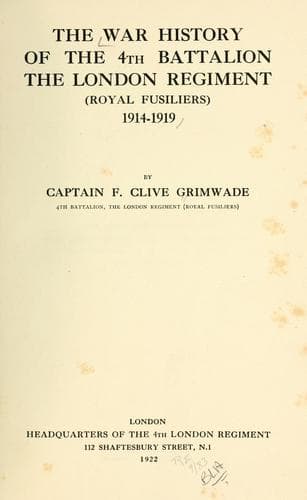
The War History of the 4th Battalion, the London Regiment (Royal Fusiliers), 1914-1919Grimwade, F. Clive
History
The War History of the 4th Battalion, the London Regiment (Royal Fusiliers), 1914-1919
Grimwade, F. Clive
Great Britain. Army. London Regiment. 4th (City of London) Battalion; World War, 1914-1918 -- Regimental histories -- Great Britain
The morning of the 9th September dawned mistily, but by 10 o'clock
the sun's rays had dispersed the haze and disclosed to the enemy the
new earth thrown up in front of our hastily dug assembly trenches. A
heavy bombardment of the assembly areas on the whole Divisional front
followed, lasting all the morning and causing a good many casualties.
The assaulting companies having already formed up over night, the
trenches were crowded with troops waiting for the hour of attack, and
the experience of having quietly to endure this remarkably accurate and
heavy shoot was one of the most trying of the whole engagement.
At 4 o'clock the enemy put down a heavy barrage on our lines. A quarter
of an hour later our preparatory bombardment, which had opened at 10
a.m., increased to "hurricane" intensity, and for half an hour the
German positions were subjected to a frightful ordeal under which it
seemed that nothing could live. At 4.45 p.m. the British columns, on a
front of several miles, moved to the assault.
The 1/4th Londons on getting out of their assembly trenches had to
make a change of direction, pivoting on their right flank, and this
accomplished, they moved forward steadily, keeping well up to their
barrage and suffering comparatively little loss.
In consequence of the conflicting reports which were received during
the action, the heavy toll of casualties in all ranks, and the
resultant intermingling of companies in the positions gained, it has
been a matter of considerable difficulty to elucidate the position and
to extract from the mass of evidence a fair and impartial account of
what really occurred.
It seems evident, however, that the position marked as the 1/4th
Londons' first objective was innocent of the trench which it was
expected to find there. At all events if a trench had ever existed on
the line of the Leuze Wood-Ginchy track it had been so battered by
shell fire as to be no longer recognisable as such; and it appears
that the greater part of the assaulting companies overshot the mark
and moved straight on to what was really the second objective, which
they occupied under the impression that it was the first objective.
It had been arranged that A Company on the left should consolidate
a strong point on the left of the real first objective at its point
of junction with the sector to be captured by the Rangers. Evidently
2/Lieut. Brodie, to whom was allotted this task, in making his change
of direction to the right took a somewhat wide sweep and struck the
east end of the Rangers' first objective, where a trench did actually
exist, and here he formed his block practically in the position where
it was intended to be. Subsequently Brodie, finding himself, no doubt,
out of touch with the remainder of the Battalion, who had gone too far,
came forward in the attempt to clear up the situation, but unhappily
was killed, together with all his men.
Public-domain text, read in full here on John Shaqi.
Reviews
Reviews
No reviews yet
Be the first to share your thoughts on this work.
Elsewhere in the archive
Join the Discussion
Join the discussion
Sign in to leave a comment or review.
Sign InorCreate an account