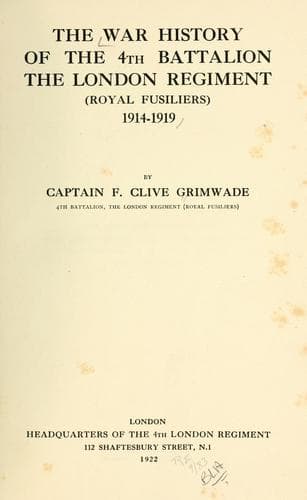
The War History of the 4th Battalion, the London Regiment (Royal Fusiliers), 1914-1919Grimwade, F. Clive
History
The War History of the 4th Battalion, the London Regiment (Royal Fusiliers), 1914-1919
Grimwade, F. Clive
Great Britain. Army. London Regiment. 4th (City of London) Battalion; World War, 1914-1918 -- Regimental histories -- Great Britain
The too rapid advance of the Battalion naturally brought them under the
fire of our own barrage, and during the forty minutes' pause which was
ordered after the capture of the first objective before the resumption
of the advance on to the second, a good many casualties did in fact
occur from our own shells which were dropping in and uncomfortably
close to the trench which was occupied. This trench--the real second
objective--was subsequently known as Bully Trench. We will therefore so
refer to it in order to avoid confusion.
At 5.25 p.m. the Battalion, now including elements of all companies,
once more advanced in a commendably steady manner on to a trench just
topping the rise of the Main Ridge. This it occupied with very little
opposition. This advanced position--Beef Trench--was an isolated trench
about 150 yards ahead of Bully (the real second objective) with both
flanks in the air. It was shallow and evidently only in course of
construction. It afforded magnificent observation over the rearward
slopes of the Main Ridge on to the German third line system in front of
Morval, and in this position the work of consolidation was begun, two
Lewis gun posts being pushed forward overlooking the Morval-Lesbœufs
Road. Middle Copse, a small spinney about 200 yards to the front, was
seen to be teeming with Bosche who were effectively dealt with by our
Lewis guns.
In the meantime the right platoon of B Company under 2/Lieut. Garratt,
which, in keeping touch with the Queen Victorias, had got ahead of the
rest of the Battalion, had evidently become deflected slightly to the
right during its advance and had dropped into the communication trench
connecting Leuze Wood with Bully Trench. Apparently somewhat confusing
his direction in the total absence of landmarks, Garratt moved along
this trench and turned the corner to the left along Bully Trench.
Here he came in contact with a Bosche bombing party, and attacking
them vigorously pushed them back for some considerable distance, and
eventually constructed a temporary block in the trench, probably about
the centre of the Battalion's sector, _i.e._ about 200 yards short of
the Quadrilateral. In this bomb fighting the men of B Company displayed
great courage and dash, and their accurate throwing contributed largely
to their success. Among these gallant men Corpl. Udall was conspicuous,
and for his devotion to duty he was awarded the Military Medal.
Public-domain text, read in full here on John Shaqi.
Reviews
Reviews
No reviews yet
Be the first to share your thoughts on this work.
Elsewhere in the archive
Join the Discussion
Join the discussion
Sign in to leave a comment or review.
Sign InorCreate an account