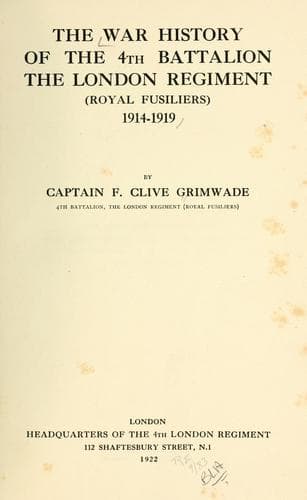
The War History of the 4th Battalion, the London Regiment (Royal Fusiliers), 1914-1919Grimwade, F. Clive
History
The War History of the 4th Battalion, the London Regiment (Royal Fusiliers), 1914-1919
Grimwade, F. Clive
Great Britain. Army. London Regiment. 4th (City of London) Battalion; World War, 1914-1918 -- Regimental histories -- Great Britain
During the advance of the assaulting companies of the Battalion from
Bully Trench to the advanced position in Beef, a somewhat determined
attack was delivered against B Company's block by a large party of the
enemy led by an officer. Fortunately the shallowness of the trench
exposed the enemy's advance and after a brisk exchange of bombs,
in the course of which some loss was inflicted on the attacking
party, including the officer who was shot by Garratt, the survivors
surrendered with the exception of a few who fled pursued by the fire of
our men and the Rangers. Garratt was subsequently awarded the Military
Cross for his good work.
On the Battalion's left the Rangers, whose line of advance was
dominated by the Quadrilateral and a small spur running from it in a
south-westerly direction, had been faced with a withering machine-gun
fire under which advance was utterly impossible. Their left company was
unable to make progress, and by 8.30 p.m. was compelled to withdraw
to its assembly positions in conjunction with the right Brigade of
the 16th Division who had also been unable to overcome the German
resistance. The right company of the Rangers pushed gallantly forward
losing heavily, but was finally brought to a stand in the vicinity of
the temporary block which was being held in Bully by Garratt. Here they
were forced to take such cover as shell craters afforded them, and to
reply to the Bosche fire, in which they were assisted by the party of B
Company at the block. Under the gathering darkness a good many of the
Rangers were able to make their way into Bully trench.
While all this was taking place two companies of the Kensingtons had
occupied the assembly trenches vacated by the 1/4th Londons, and the
commanders of these, appreciating the situation of the Rangers, at once
made a gallant attempt to fill the gap on the left. Their gallantry,
however, cost them dear, and the German barrage took a heavy toll of
casualties before they reached Bully Trench. The bravery of Major
Dickens was in particular remarkable. Mortally wounded some time before
he reached his objective, he continued to advance at the head of his
men, cheering and encouraging them until he collapsed into the trench.
Later in the evening the two remaining companies of the Kensingtons
were also thrown into the fight and became absorbed into the 1/4th
Londons' position in Bully Trench.
Darkness had now fallen, and the position of the companies in the
advanced trench was far from happy. Both flanks were in the air and
heavy losses had been suffered; of the officers who had started
with these companies, only four--Cooper, McCormick, Quennell and
Burford--were still standing. News from Garratt showed that he was
doubtful as to whether he could hold out against another attack.
Public-domain text, read in full here on John Shaqi.
Reviews
Reviews
No reviews yet
Be the first to share your thoughts on this work.
Elsewhere in the archive
Join the Discussion
Join the discussion
Sign in to leave a comment or review.
Sign InorCreate an account