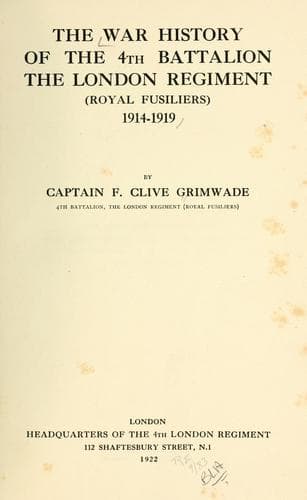
The War History of the 4th Battalion, the London Regiment (Royal Fusiliers), 1914-1919Grimwade, F. Clive
History
The War History of the 4th Battalion, the London Regiment (Royal Fusiliers), 1914-1919
Grimwade, F. Clive
Great Britain. Army. London Regiment. 4th (City of London) Battalion; World War, 1914-1918 -- Regimental histories -- Great Britain
The 16th Division on the left had also met with varied fortunes. The
47th Brigade on its left had successfully advanced through Ginchy
and established itself on its objective; but the right brigade, the
48th, whose objective lay along the Ginchy-Morval Road, met with most
stubborn resistance from the spur already referred to. In spite of
the most gallant efforts the Brigade was unable to make progress, and
eventually fell back with the left wing of the Rangers at about 8.30
p.m. and reoccupied their original position on the Wedge Wood-Ginchy
Road. About this time the London Scottish were ordered into the fight
in order to endeavour to clear up the situation in this part of the
field. After the march forward from Maltzhorn their preparations were
completed at about midnight, and shortly after they attacked from
a position to the left of the Rangers' assembly trenches towards
the Quadrilateral. The enemy was still vigorous in his defence, and
after losing their direction in the intense darkness, the Scottish
were ultimately withdrawn, having first rendered a good account of
themselves in a lively little hand-to-hand fight with a party of the
Bosche. During the night the 16th Division was relieved by the 3rd
Guards Brigade.
Shortly after dawn on the 10th 2/Lieut. McCormick, who had come back
to Battalion Headquarters with a report of the situation, returned to
Beef Trench with orders for the immediate evacuation of the advanced
position. Accordingly, after establishing two Lewis gun positions in
Beef Trench, the withdrawal was proceeded with as rapidly as possible,
the activity of the German snipers in the growing daylight making
movement difficult except in the smallest parties. The return of the
1/4th Londons to Bully Trench caused congestion which was subsequently
intensified by the arrival of a large reinforcement of London Scottish.
This Battalion made efforts during the day to prolong the line in the
direction of the Quadrilateral, while the Guards, working eastward
along the Ginchy-Morval Road, sought to join hands with them, but
the Germans were well supplied with bombs and put up a very gallant
resistance. The continued occupation of the spur--which on the previous
day had stopped the 16th Division--moreover forced an unpleasantly deep
re-entrant in the British line, leaving the left flank of the 1/4th
Londons dangerously exposed. An effort to rout out the pertinacious
defenders of this spur was made during the afternoon by the 168th
Stokes mortars, who fired 35 rounds with good effect into the enemy
trenches.
The position on the right flank of the Battalion was still less
satisfactory than had been hoped for. At 7 a.m. and again at 3 p.m. the
Queen's Westminsters had made local attempts to gain the previous day's
objective, but each time without success.
Public-domain text, read in full here on John Shaqi.
Reviews
Reviews
No reviews yet
Be the first to share your thoughts on this work.
Elsewhere in the archive
Join the Discussion
Join the discussion
Sign in to leave a comment or review.
Sign InorCreate an account