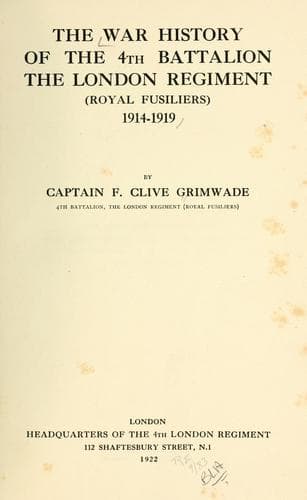
The War History of the 4th Battalion, the London Regiment (Royal Fusiliers), 1914-1919Grimwade, F. Clive
History
The War History of the 4th Battalion, the London Regiment (Royal Fusiliers), 1914-1919
Grimwade, F. Clive
Great Britain. Army. London Regiment. 4th (City of London) Battalion; World War, 1914-1918 -- Regimental histories -- Great Britain
Throughout the day the Battalion's position was kept under heavy German
shell fire which caused the already heavy casualty roll to mount higher
and higher, and it was found necessary to relieve the congestion
in Bully by withdrawing the Rangers and Kensingtons to the rear.
Communication with Headquarters was rendered exceedingly difficult,
though, as always, there was no lack of brave volunteers to try to
pass through the German barrage, and these in some cases succeeded
in reaching the report centre in Leuze Wood. Moreover the trench,
only a shallow and half-finished work to start with, was becoming
badly shattered and was filled with wounded men, whom there was no
means of evacuating, for all the stretcher-bearers with companies had
themselves become casualties. Throughout this trying day all ranks
displayed magnificent spirit and clung to their hardly won gains with
grim determination. That night the 168th Brigade was relieved, the
1/4th Londons handing over their objective to the 8th Middlesex of the
167th Brigade. Following the relief, which was complete by midnight,
the Battalion moved by companies--by now sadly reduced in numbers--to
Casement Trench, whence the Battalion moved as a unit to Billon Farm,
near Carnoy, arriving in bivouacs there at 5.30 a.m. on the 11th
September.
[Illustration: THE BATTLE OF GINCHY, SEPTEMBER 1916]
The five days' duty just completed were perhaps the most strenuous
the Battalion had yet experienced. Almost all the time exposed to bad
weather conditions and to very heavy and accurate artillery fire, the
spirit of the men was magnificent; and their steadiness, after the loss
of 15 out of the 20 officers who led the companies into action, as well
as a large proportion of N.C.O.'s, was unsurpassed. Their fighting
qualities too were firmly established, for they had taken their
objectives up to time-table and handed them over intact twenty-four
hours later. The total casualties during the five days amounted to 22
officers and about 250 other ranks.
The officer casualties were as follows:
7th and 8th September--Capts. F. O. J. Read and H. G. Stanham,
2/Lieuts. W. Richards, A. Potton, J. T. Middleton, C. H. T.
Heaver and L. W. Archer, wounded.
9th and 10th September--Capt. J. R. Webster, 2/Lieuts. C. J.
Brodie, F. J. Foden, W. E. Osborne, C. E. Lewis, C. S. G. Blows
and C. F. Mortleman, killed; Lieuts. H. W. Vernon and G. H.
Davis, 2/Lieuts. J. W. Price, V. R. Oldrey, C. F. English, N.
A. Ormiston and J. C. Graddon, wounded; and 2/Lieut. W. H.
Davey, D.C.M., missing, presumed killed.
Public-domain text, read in full here on John Shaqi.
Reviews
Reviews
No reviews yet
Be the first to share your thoughts on this work.
Elsewhere in the archive
Join the Discussion
Join the discussion
Sign in to leave a comment or review.
Sign InorCreate an account